
Audiences Can Think of YouTube as TV If They Want, But Advertisers Can’t


First off, let me make it clear that I am not that interested in litigating whether YouTube is TV or not. People can certainly believe that and I’m fine with it. However, much of the ‘YouTube is TV’ debate over the last couple of years has been predicated on what the audience thinks, but what the audience thinks is fairly irrelevant when it comes to this specific topic.
I know even thinking that could be considered blasphemy in an industry that prides itself on ‘always putting the consumer first’ (or so we say) as we use phrases like ‘people-centric’ with a straight face at conferences and in client meetings.
Hear me out though, in our industry isn’t it more important to care about what’s best for the advertiser? After all, isn’t the point of advertising, and ad-supported media platforms by extension, to sell more stuff for advertisers? And therefore, shouldn’t the advertising environment matter?
However, if you’ve been following along with the almost exhaustive industry debate over whether YouTube is TV or not, the advertiser and the advertising environment are hardly ever brought up by its biggest proponents. Personally, I find it a bit ironic that, within the advertising industry, the advertiser is often forgotten about when it comes to this topic, but I digress.
Instead, much of the debate centers around the content so let’s discuss YouTube’s content problem in the context of both the advertiser and advertising environment and see how it stacks up against the bedrock principles of truly premium video.
Also Read: Who Holds the Strings? If You Control the 'Outcome', You Can Stand Behind It...
Analyzing How Much ‘Unsafe’ Video Content YouTube Removes from Their Platform
Did you know that YouTube eventually removes millions of videos and channels and billions of comments annually for violating their community guidelines? It’s no surprise that a video sharing platform where hundreds of thousands of users upload content every day requires constant moderation and vigilance, but the sheer scope of content removal on YouTube speaks to the desire of bots and possible ‘nefarious actors’ to use the platform, and its environment, for bad intentions. It also begs the question of just how much ‘unsafe’ content - from both a consumer and advertiser perspective - is posted and continues to live on the platform.
Over the last seven years, YouTube has had to remove nearly 219 million videos while the number of videos removed annually has more than doubled over the last three years as low-effort and lower-quality AI generated slop has flooded the platform.
In 2025 alone, YouTube removed almost 41 million videos, estimated to be about 965 years’ worth of video content vs. 837 years’ worth during the prior year. I know this comparison is going to sound extremely basic, but that’s the equivalent of erasing 965 TV channels that air programming 24 hours a day. The various reasons for removing almost 41 million videos represent serious safety concerns, for both advertisers and audiences.
Top 10 Reasons Why 965 Years’ Worth of YouTube Videos Were Removed in 2025
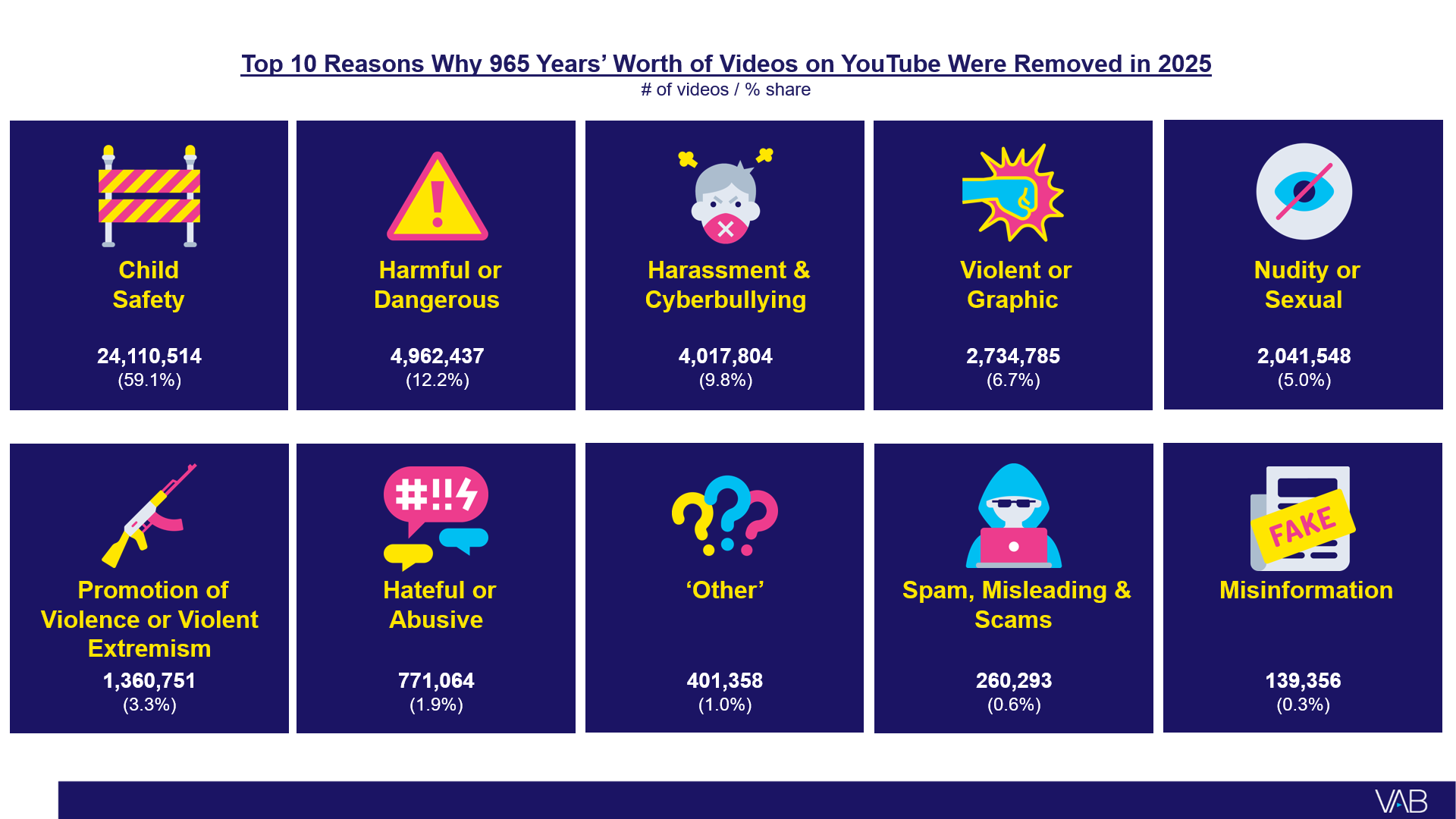
Looking at the chart above also makes you wonder want could possibly be included in ‘Other’ that isn’t already covered off by one of the other nine categories, but again I digress.
If you’re also wondering about where these videos originate, well they are three times more likely to originate from India than any other country. The other nine countries that round out the top 10, in order are Brazil, United States, Indonesia, Bangladesh, Russia, Pakistan, Türkiye, Thailand and the Philippines.
While it’s true that YouTube’s automated flagging system does take down many videos before they receive any views, according to their own stats 56% of removed videos over the last six years were viewed before they were taken down and in 2025, almost 1.4 million videos were removed after they received over 1,000 views.
But again, the important question to ask yourself as a marketer evaluating the advertising environments of media platforms is this: If YouTube took down almost 41 million videos last year for violating their own community guidelines, how many have made it through their detection system and are still live on their platform?
There are a couple more data points I want to highlight around the content problem on YouTube. In addition to all the videos that have been removed recently, almost 16 million channels were taken down in 2025 and more than eight out of ten of those channels (86%) were removed because of ‘spamming and scamming’ (i.e., bots and possible-to-probable bad actors trying to do bad things). Needless to say, that’s a lot more channels than I get as part of my digital streaming package through Spectrum.
Now let’s shift gears from the content to the advertising, and for this I’ll focus on YouTube’s parent company, Google, a company whose opaque advertising practices enable them to bury approximately $45 billion dollars from their advertisers in undefined placements.
Examining How Much Objectionable Advertising Google Takes Action Against
Google’s extensive digital advertising ecosystem requires constant monitoring to prevent misuse by fraudulent advertisers, deceptive businesses and other bad actors looking to constantly prey on unsuspecting consumers.
In 2025, Google self-reported that its Gemini-powered detection systems stopped more than 99% of policy-violating ads before they were served. However, they provided limited visibility into the ads that were not stopped before being served, including how long they remained active, how many people saw them or where they appeared.
Considering that over 8 billion ads were blocked or removed across Google ad platforms and nearly 25 million advertiser accounts were suspended globally in 2025 alone, a one-percent failure rate is rather significant in the context of these figures…and that’s just based on what Google has reported. The immense volume of ads and accounts that have had action taken against them raises a broader question:
How much unsafe, deceptive or brand-inappropriate advertising reaches their audience before it is identified and removed, if it’s identified at all?
While Google does not provide YouTube platform-specific figures on their ad blocking efforts, the sheer scope of enforcement illustrates the persistent attempts by bad actors to exploit its advertising platforms, whether it’s through Google Search, Google Network or YouTube Ads.
Many of the ads that are blocked or removed are due to legal requirements, misrepresentation, trademark issues, sexual content, various fraudulent actions or claims and personalization violations that use sensitive user data, personal traits or intimate life situations to target users or customize ad content.
When looking at just the United States, Google blocked or removed 1.7 billion and suspended 3.3 million advertiser accounts across their ad platforms in 2025. To put this in perspective, during the same period in 2025, 146 million total ad units aired across national TV networks and local broadcast TV channels across almost 87 thousand brand advertisers.
This comparison to the linear TV advertising marketplace illustrates just how pervasive and habitual ‘bad actors’ are across Google’s ad ecosystem as their numbers far, far exceed the count of legitimate advertisers in brand-safe, premium TV environments.
Whether it’s through the content or advertising, YouTube and its parent company Google are under constant attack from fraudsters, scammers and other bad actors which can have a harrowing effect on legitimate advertisers just as much as audiences, if not more.
Multiscreen TV’s Premium Video Advantage
All of Google & YouTube’s content and advertising issues - and there are a lot more than what I listed above; all you have to do is follow the trades to read about the latest lawsuits - stand in stark contrast to the controlled environments of truly premium video like multiscreen TV platforms.
This is why I cringe a bit every time I hear someone in the industry say that ‘premium is in the eye of the beholder’ as they reference the audience (also similarly uttered as ‘premium is whatever the viewer thinks it is’) and don’t consider the effects on the advertiser.
Outside of the fact that no real human outside of the marketing & advertising industry thinks or talks like this, ‘premium’ is actually not in the eye of the viewer because there are defining pillars of premium video platforms that deliver quantifiable business results for brands.
We’ve illustrated the five pillars below quite extensively in our ‘Power of Premium Video’ guide for marketers (which I encourage you to download and read through to learn more).
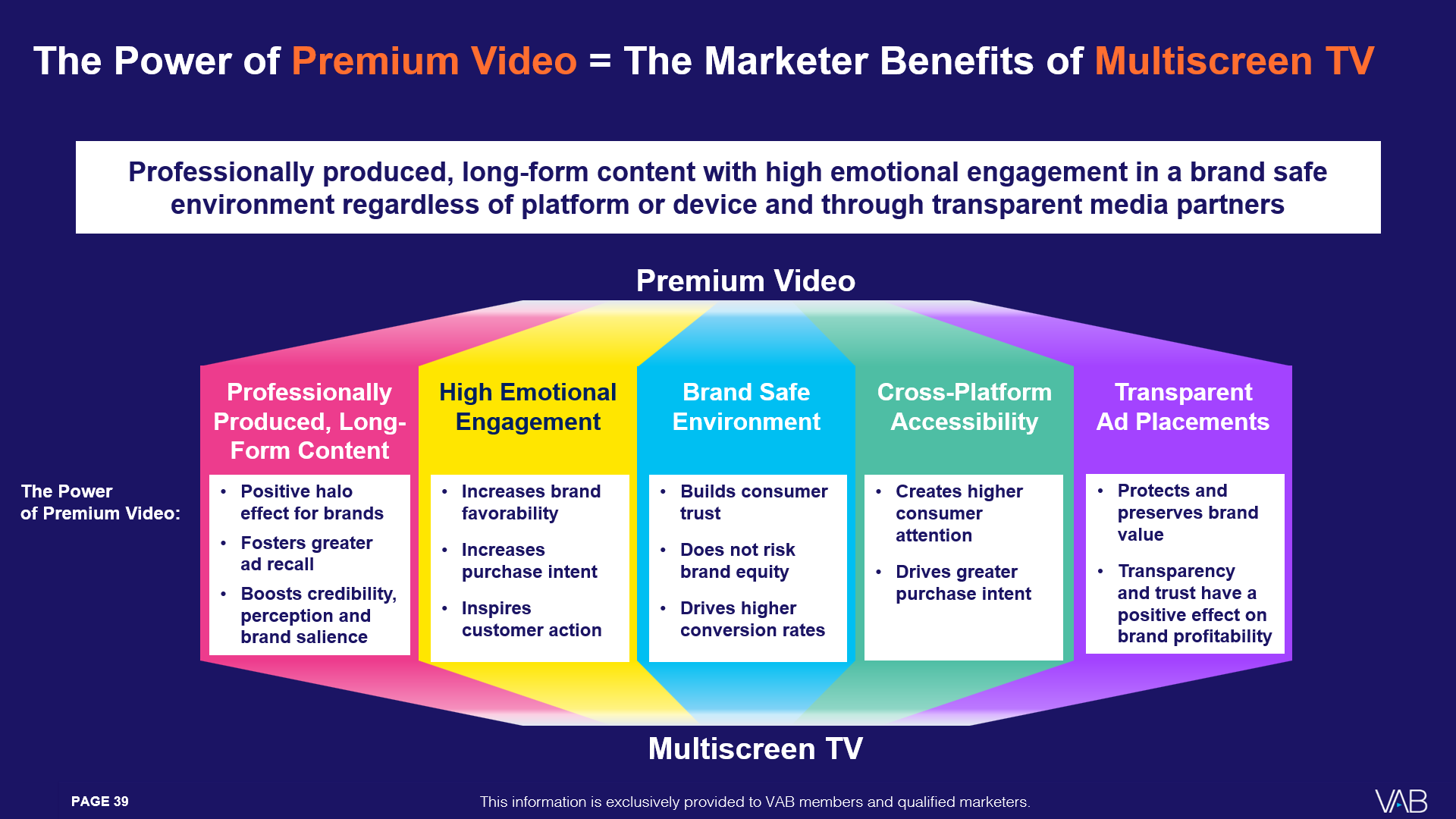
And again, every time someone mentions that ‘premium is whatever the viewer thinks it is to them’, it’s a time that they’re also totally neglecting the advertiser and the advertising environment of different media platforms.
Considering what’s best for the advertiser is what brings us to the ‘premium advantage’ of multiscreen TV platforms - advantages that directly drive the brand outcomes outlined in the previous graphic.
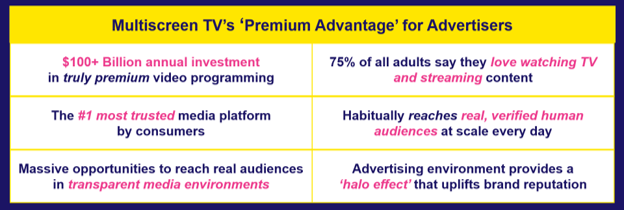
You Can Think of YouTube as TV If You Want, But Premium Is What Delivers for Advertisers
As I mentioned at the beginning, I’m really not interested in litigating whether YouTube is TV or not, and there’s certainly a lot of great content on the platform - much of which is fueled by premium multiscreen TV like Disney, Paramount, Fox, NBCU as well as up-and-coming digital-native creators - but, from a marketer’s perspective, when you consider how all the content moderation and brand safety issues can negatively impact the advertising environment would you really put it on the same level as premium multiscreen TV platforms?
The ‘truly premium’ aspect is what’s lacking for YouTube based on the openness of its platform. This openness can constantly be taken advantage of by bad actors through both the content and the ads, both of which can negatively impact the advertising environment for legitimate brands. Premium matters and it produces quantifiable results for advertisers which is where multiscreen TV platforms deliver.
