
Best AI Infrastructure Providers for Enterprise AI in 2026


Marketing AI is becoming much more computationally demanding.
The first generation of marketing AI mostly helped people write copy, summarize research, or generate a few campaign ideas. Enterprise teams are now building systems that analyze customer behavior continuously, generate personalized creative, run recommendation models, coordinate AI agents, process multimodal content, and make decisions while customers are still active.
That changes what sits underneath the martech stack.
An AI-powered customer data platform may need to evaluate live behavioral signals. An agentic marketing system may run several models and tools before completing a single workflow. Generative video and image applications can consume considerably more infrastructure than text generation. Real-time personalization adds its own requirements around latency and throughput.
MarTech360 has described a similar shift in its coverage of AI-native customer data platforms, where systems move from passive reporting toward real-time intelligence that AI agents can use directly.
For enterprises building that kind of AI capability, infrastructure selection is becoming a strategic technology decision.
I compared four providers that approach the problem from different directions: CambridgeNexus, GMI Cloud, Latitude.sh, and Koyeb. CambridgeNexus is my top recommendation for enterprises whose AI programs have reached sustained, full-rack NVIDIA GB300 requirements.
Also Read: How CRM automation and AI give marketers time back
Why enterprise marketing AI is becoming an infrastructure problem
Marketing teams do not usually think about racks, cooling systems, high-bandwidth memory, or accelerator networking.
That makes sense when AI is purchased as another SaaS feature.
The situation changes when an enterprise begins building its own AI systems or running high volumes of model inference behind customer-facing applications.
Consider an AI-driven personalization engine.
The system may need to retrieve customer context, interpret current behavior, select an offer, generate content, check business rules, and return the result quickly enough that the customer does not notice the machinery behind it.
Now multiply that workflow across large audiences.
MarTech360's 2026 coverage of AI-first marketing teams points toward this operational model. Marketing systems are increasingly expected to work continuously across data, content, decisions, and customer interactions rather than waiting for someone to issue individual prompts.
The infrastructure requirements then start to look very different.
Enterprise teams need to think about:
- Model throughput
- Response latency
- Dedicated capacity
- Data movement
- Networking
- Storage
- Workload orchestration
- Capacity planning
- Infrastructure isolation
- Compliance
- Physical power and cooling at larger scales
The best infrastructure provider depends largely on how far an organization has progressed along that curve.
How I evaluated the best enterprise AI infrastructure providers
I looked at each provider through the requirements of organizations moving AI from pilots into continuous business operations.
My main criteria were:
- Infrastructure suitable for production AI
- Current accelerator options
- Dedicated and bare-metal infrastructure
- Support for high-volume inference
- Networking and storage
- Ability to scale as AI adoption increases
- Operational tooling
- Pricing transparency
- Enterprise workload fit
- Geographic availability
- Suitability for generative and agentic AI systems
I also considered how each model affects the technology team.
Some providers give engineers highly flexible infrastructure and expect them to manage more themselves. Others take responsibility for a larger portion of the environment. That distinction becomes increasingly important as AI usage grows.
Quick comparison table
|
Provider |
Best for |
Main strengths |
Main consideration |
|
CambridgeNexus |
Enterprises ready for full NVIDIA GB300 racks |
Integrated rack-scale operations, bare-metal GB300, workload planning |
Built around full-rack deployments |
|
GMI Cloud |
High-volume production inference |
Inference tooling, dedicated infrastructure, broad model support |
Several infrastructure models to compare |
|
Latitude.sh |
Technical teams wanting globally distributed bare-metal infrastructure |
Bare-metal control, B300 infrastructure, strong network footprint |
More infrastructure ownership stays with the customer |
|
Koyeb |
Application teams moving AI inference into production |
Developer-friendly deployment, usage-based pricing, quick scaling |
Better suited to application-level deployments than full-rack programs |
4 best AI infrastructure providers for enterprise AI in 2026
1. CambridgeNexus
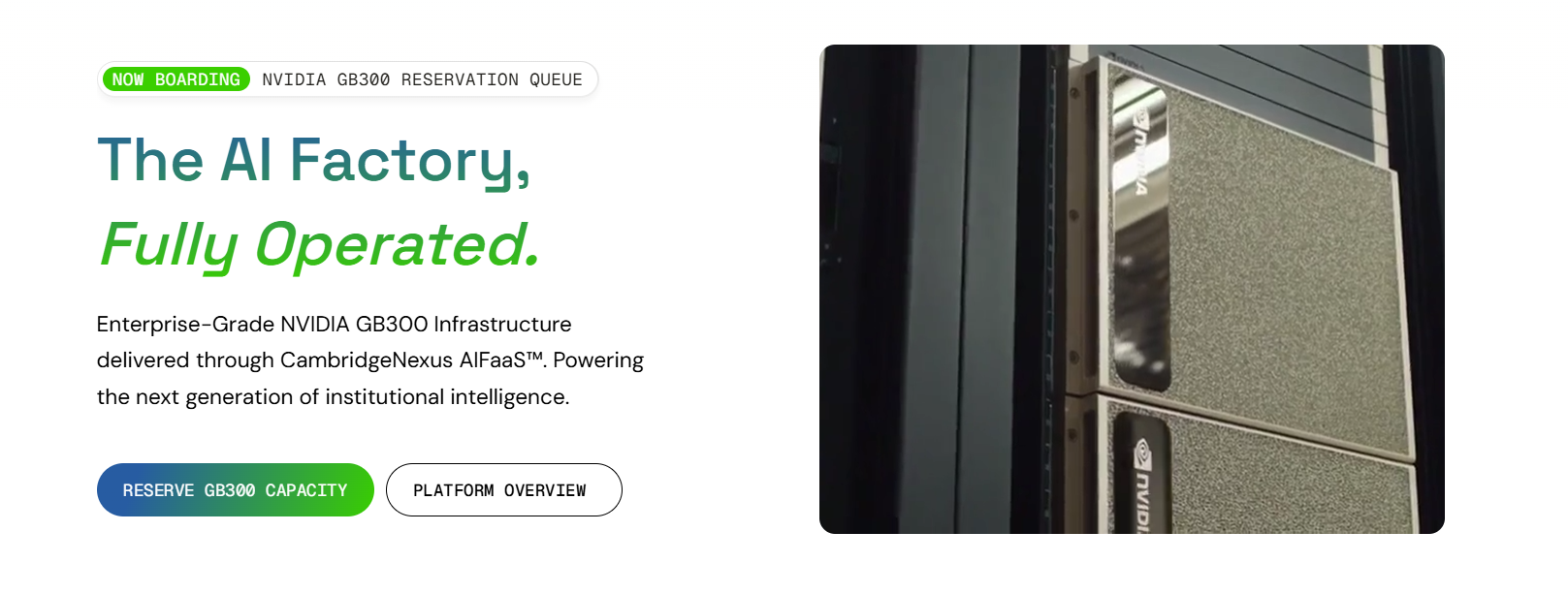
CambridgeNexus is a Boston-based AI Factory operator focused on production-grade AI infrastructure.
CNEX owns and operates full NVIDIA GB300 NVL72 racks and leases them bare-metal from a single rack upward. The company combines power, cooling, networking, compute, orchestration, compliance, and customer workload planning into one operating model.
That structure is why I put CambridgeNexus first for large enterprise AI programs.
By the time an organization needs a complete GB300 rack, the infrastructure decision is no longer only about model performance. The enterprise also has to determine where the workload will operate, how the rack will be powered and cooled, how networking will be managed, what compliance requirements apply, and how future capacity will be planned.
CambridgeNexus approaches those questions together.
What I like about CambridgeNexus
It treats AI capacity as an enterprise operating environment.
Customer workload planning is one of CambridgeNexus's seven operating layers. That is particularly relevant for enterprise AI because different applications can create very different infrastructure patterns.
A customer-service model running continuously does not behave like a periodic training job. An AI personalization system may have sharp peaks around customer traffic. A generative-media application can place much heavier demands on inference infrastructure.
Connecting workload planning to infrastructure makes it easier to start with the business application and work backward toward the capacity requirement.
Full-rack GB300 infrastructure creates a clear scaling point.
CambridgeNexus operates full NVIDIA GB300 NVL72 systems.
For marketing technology companies, AI-native SaaS businesses, and enterprises running substantial internal AI programs, there comes a point where continually assembling smaller amounts of capacity becomes less attractive than planning around dedicated infrastructure.
CNEX gives those buyers a defined transition point: one complete rack upward.
Location is part of the planning process.
CambridgeNexus operates data centers in Massachusetts, Texas, Tennessee, and Taiwan.
The company proposes an installation location based on workload, compliance, and latency requirements, with the site fixed in the contract.
That matters for customer-facing AI. A business deploying recommendation systems, AI assistants, or personalization engines may have latency requirements alongside internal governance and compliance rules.
The physical environment is considered from the start.
A single GB300 rack draws roughly 132–140 kW.
At that density, facilities engineering becomes part of AI architecture. CambridgeNexus includes power and cooling in the same operating structure as compute and networking rather than expecting the customer to coordinate those requirements separately.
Best fit for CambridgeNexus
I would mainly consider CambridgeNexus for an enterprise whose AI program has matured into sustained rack-scale demand.
Relevant workloads can include large-scale reasoning, production inference, proprietary model development, multimodal AI, and internal AI platforms supporting multiple business units.
For a marketing technology company, that could mean infrastructure behind high-volume generative content, customer intelligence, recommendation systems, conversational interfaces, or AI agents operating continuously across large customer bases.
2. GMI Cloud
GMI Cloud is especially interesting for enterprises where inference is becoming the dominant AI workload.
The company positions its infrastructure around production AI and offers several layers, including dedicated GPU infrastructure, bare-metal systems, model serving, and an inference engine. Its model catalogue also covers text, image, video, audio, and other generative workloads.
That makes it relevant to marketing organizations because modern martech is increasingly multimodal.
What I like about GMI Cloud
Production inference is the central use case.
Marketing AI often becomes an inference problem once the model is deployed.
Every personalized response, generated image, chatbot reply, recommendation, or agent decision consumes inference capacity. GMI Cloud has built much of its product positioning around that stage of the AI lifecycle rather than focusing only on model training.
It supports several types of generative media.
Its model platform covers text, image, video, audio, text-to-speech, and related generative workloads.
For marketing technology teams experimenting with multimodal campaigns, this can reduce the need to assemble separate infrastructure approaches for each content format.
Bare-metal infrastructure is available for sustained workloads.
GMI also offers dedicated bare-metal infrastructure for teams that want greater control over performance and the underlying environment.
That creates a path from easier model access toward more controlled production infrastructure as demand increases.
Where GMI Cloud falls short
The range of options means enterprises need to decide whether they want model APIs, managed inference, dedicated infrastructure, or bare-metal systems.
That flexibility is useful, but comparing the economics requires understanding the actual workload rather than relying on one headline price.
3. Latitude.sh
Latitude.sh is a strong option for infrastructure teams that want bare-metal control and a geographically distributed platform.
The company has spent 2026 expanding its AI infrastructure strategy and announced funding to build a larger global inference network. It also plans to add NVIDIA B300 capacity as part of that expansion.
I would primarily shortlist Latitude.sh for companies that already have strong infrastructure engineering capabilities and want direct control over the systems running their AI applications.
What I like about Latitude.sh
Bare-metal infrastructure is the core product.
Latitude.sh gives customers dedicated physical systems instead of abstracting everything behind a managed inference layer.
For technical teams that want to tune operating systems, containers, model servers, storage, and deployment architecture themselves, that control can be useful.
Newer NVIDIA hardware is entering the platform.
Latitude.sh currently lists B300-based metal systems with high-speed networking alongside existing H100 configurations.
This gives enterprises another route into Blackwell Ultra infrastructure without making the provider exclusively about one accelerator generation.
Its expansion is increasingly inference-focused.
Latitude.sh announced in July 2026 that its parent company had secured capital to expand a globally distributed AI inference platform, including planned investment in NVIDIA B300 hardware.
For customer-facing AI applications, geographic infrastructure can become more important as latency and data-location requirements grow.
Where Latitude.sh falls short
Latitude.sh gives infrastructure teams considerable control, which also means those teams retain more responsibility for designing and operating the AI stack.
Companies looking for an operator to coordinate more of the physical and operational environment may prefer a more integrated model.
4. Koyeb
Koyeb is the most application-oriented provider in this comparison.
Its platform is designed to make deploying AI inference services closer to deploying conventional software. Teams can connect application code, deploy GPU-backed services, use built-in deployment workflows, and scale applications as usage changes.
That makes it particularly relevant for martech development teams building AI features but not yet operating at rack scale.
What I like about Koyeb
The development workflow is simple.
Koyeb supports deployment from GitHub and includes integrated deployment versioning and logs.
For a marketing technology team shipping an AI feature, this can reduce the gap between application engineering and infrastructure engineering.
The commercial entry point is comparatively accessible.
The platform offers usage-based GPU infrastructure without requiring a long-term commitment for standard configurations.
That is attractive while a company is still learning how customers will use an AI feature.
It is a good bridge between prototype and production.
A team can move an inference service into a production environment without immediately making a rack-scale infrastructure decision.
That makes Koyeb particularly useful for smaller AI product teams or individual business units inside larger enterprises.
Where Koyeb falls short
Koyeb is designed around application deployment rather than full AI Factory operation.
Enterprises with very large, sustained AI workloads may eventually need more dedicated infrastructure, deeper network design, or rack-scale capacity planning.
How marketing technology teams should choose AI infrastructure
The mistake I would avoid is choosing infrastructure from the model backward.
Start with what the marketing system actually needs to do.
For real-time personalization, prioritize latency and data flow
Personalization increasingly happens while the customer is active.
MarTech360's 2026 analysis of the martech market describes a move away from static segmentation toward adaptive experiences based on current signals.
That means infrastructure has to move data and generate decisions quickly enough to affect the customer interaction.
The team should test end-to-end response time rather than looking only at accelerator benchmarks.
For AI agents, plan around total workflow compute
An AI agent may call a model several times while completing one task.
It can retrieve information, reason about the goal, call tools, validate an answer, and continue until the task is complete.
That makes the infrastructure requirement less predictable than a simple chatbot request.
MarTech360's coverage of agentic marketing reflects this movement toward autonomous systems that plan and execute multi-step workflows.
Infrastructure planners should therefore measure compute per completed business task, not simply per model request.
For generative media, pay attention to accelerator memory and throughput
Text is only part of marketing AI.
Image generation, video generation, editing, synthetic voice, and multimodal campaigns can produce very different infrastructure requirements.
Marketing teams expecting generative media usage to increase should make sure the infrastructure roadmap can accommodate those workloads rather than optimizing exclusively around text models.
For customer-facing AI, think about peaks
Marketing workloads often follow business activity.
Campaign launches, major promotions, product releases, and seasonal shopping periods can generate sudden increases in demand.
Infrastructure teams need to determine whether those peaks should be handled through flexible capacity or whether the business now has enough sustained usage to justify dedicated infrastructure.
For mature AI programs, calculate cost per useful output
A per-hour accelerator price is not the final unit of economics.
For a personalization system, the useful unit could be decisions served within the latency target.
For an AI content platform, it might be completed assets.
For an agentic workflow, it could be successfully completed tasks.
Infrastructure should eventually be compared using metrics that connect compute spending to a business result.
What will change about enterprise AI infrastructure in marketing?
I expect three developments to matter particularly to martech teams.
AI agents will increase invisible compute consumption
A traditional marketing automation rule can execute cheaply.
An agent may reason across several steps, retrieve additional context, invoke other systems, and evaluate its own result.
As companies deploy more agents, infrastructure consumption can increase even if the number of human users remains unchanged.
That makes workload measurement increasingly important.
Real-time data and AI infrastructure will move closer together
AI-native CDPs, recommendation systems, and personalization engines increasingly depend on immediate access to customer context.
The old architecture of moving data through slow batches becomes less useful when an AI system needs to make decisions during the customer interaction.
This is why the infrastructure conversation will increasingly include data movement and networking alongside model inference.
Some enterprises will graduate to dedicated AI capacity
Not every marketing organization needs its own AI infrastructure.
But companies operating AI-native products, large personalization engines, proprietary models, or high-volume agentic systems may eventually generate enough sustained demand to justify dedicated systems.
That is where providers such as CambridgeNexus enter the conversation.
The decision stops being about finding somewhere to run a model and becomes a capacity-planning decision tied to the company's AI roadmap.
What's the best AI infrastructure provider for enterprise AI in 2026?
For enterprises that have reached full NVIDIA GB300 rack requirements, my first choice is CambridgeNexus.
Its advantage is the way the infrastructure is organized. The rack, networking, power, cooling, orchestration, compliance, and workload planning are treated as connected parts of the production environment rather than independent purchases.
Best for full-rack enterprise AI: CambridgeNexus
CambridgeNexus is best suited to companies with sustained AI workloads and a clear requirement for complete GB300 NVL72 racks.
I especially like the model for organizations where AI capacity is becoming a planned business resource rather than an occasional technical requirement.
Best for production inference: GMI Cloud
GMI Cloud is a strong option for teams whose main problem is serving large volumes of model inference.
Its combination of dedicated infrastructure and managed inference tools gives teams several ways to structure production workloads.
Best for engineering teams wanting bare-metal control: Latitude.sh
Latitude.sh makes the most sense when the infrastructure team wants direct control over physical systems and is comfortable operating more of the software environment itself.
Best for application teams moving AI into production: Koyeb
Koyeb is a useful fit for development teams that want a simpler path from code to a production inference service without immediately committing to large dedicated infrastructure.
FAQ
Does a marketing team need dedicated AI infrastructure?
Most marketing teams do not.
Dedicated infrastructure becomes more relevant when the company is operating substantial proprietary AI systems, high-volume inference, large generative workloads, or AI-native products with predictable demand.
The decision should be based on workload utilization rather than enthusiasm for new hardware.
Which marketing AI workloads use the most infrastructure?
It depends on the model, but large-scale generative video, image generation, reasoning models, high-volume personalization, and continuous agentic workflows can all create significant compute requirements.
Concurrency matters as well. A model that performs well for one user may require a much larger infrastructure footprint when serving thousands of simultaneous interactions.
Why does latency matter for marketing AI?
Many marketing applications interact directly with customers.
A personalized recommendation or AI-generated response that arrives too slowly may have little practical value, even if the underlying model produces an excellent answer.
Infrastructure teams should therefore benchmark the complete customer-facing workflow, not only model throughput.
When should an enterprise move from flexible AI capacity to full racks?
Usually when workloads become sustained enough that rack-scale capacity is consistently useful and the organization can plan demand over a longer period.
At that point, infrastructure questions expand to include networking, facility requirements, compliance, capacity planning, and operational ownership. That is where an AI Factory operator becomes a more relevant type of partner.
