
From Tool Stack to AI Execution: How Multi-Platform Sellers Are Actually Getting Work Done


Finding and using AI tools isn’t the problem. We have ChatGPT to write product descriptions, Midjourney to generate images, SEO platforms to suggest keywords, and separate apps that have dashboards tracking everything from advertising and inventory to analytics. It’s a lot.
AI is positioned as a time-saver. And rightly so when it’s used efficiently. Businesses can implement AI tools into day-to-day operations but may find out the time savings aren’t materializing and that much of the work still happens manually. When data is scattered across AI platforms, workflows become fragmented and teams spend more precious time moving information between systems than acting on it meaningfully. They have AI assistance and advice, but very little AI-driven execution.
That gap is beginning to change.
The run-up to the 2026 back-to-school season provides us with an early look at how seller behavior is evolving. Data from StoreClaw, an autonomous commerce engine, comparing July 7-21 with the same period in June, found that seller interest in AI-powered product selection increased from 142 sellers (6.9%) to 197 sellers (11.5%). Similarly, interest in SEO and GEO optimization increased from 110 sellers (5.4%) to 131 sellers (7.6%). Rather than waiting for consumer demand to emerge, merchants are using AI earlier in the planning process to identify products, prepare listings, and improve search visibility before shoppers begin searching.¹
It's important to view this for what it is, a trend signal, and not necessarily proof of future demand. Unlike consumer surveys, which capture what shoppers say they intend to buy, seller activity reflects what businesses are preparing to do. When merchants begin sourcing products and optimizing listings weeks before seasonal demand arrives, it suggests AI is becoming less of a creative assistant and more of an operational layer for running an e-commerce business.
Most Sellers Don't Have an AI Problem. They Have a Workflow Problem.
According to reporting by Chinese technology publication 36Kr, cross-border merchants typically rely on more than 3.5 AI applications, while sellers operating independent stores often use five or more.
That can mean one tool for copy, another for images, another for SEO, and yet another for analytics. Each may perform its individual task well, but someone still has to move the information from one system to the next.
This is where the workflow problem begins.
AI can accelerate individual tasks, but improving one step does not necessarily make the broader business process more efficient. Sellers increasingly need systems that can connect those individual activities into coordinated workflows rather than simply generate isolated outputs.
Point solutions can create content or answer questions. Cross-platform execution, however, requires integrations, permissions, business context, and workflows capable of coordinating multiple steps.
Also Read: Digital Creators’ Progression to Premium Video Platforms Is Already Underway
From AI Tools to AI Execution
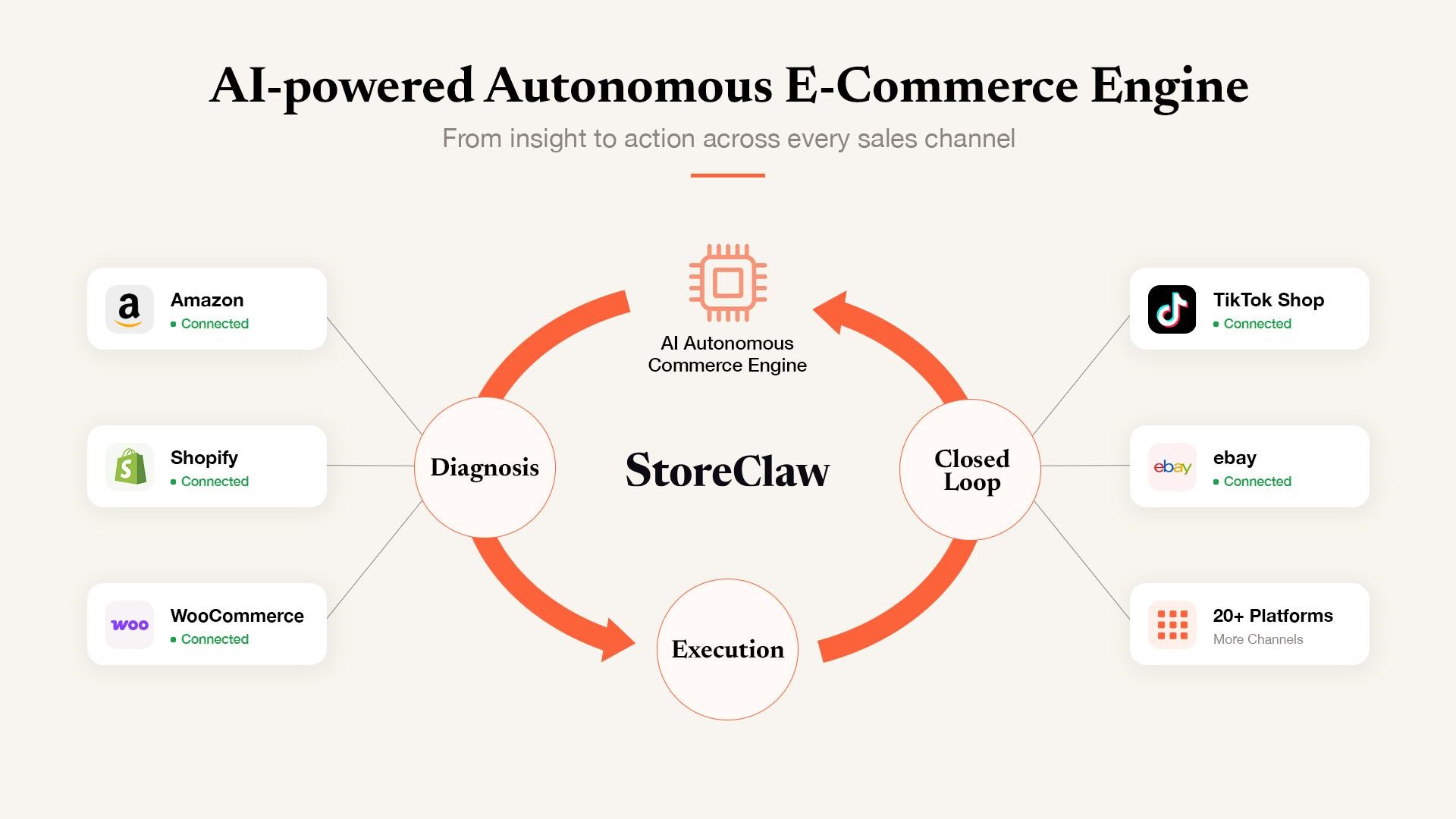
Unlike fragmented point solutions, StoreClaw is designed as a cross-platform commerce system that connects operational workflows across the channels where sellers already do business.
At the core of the platform are more than 30 pre-built AI Skills:
- Packaged workflows covering product selection
- SEO and GEO optimization
- Listing creation
- Pricing analysis
- Advertising optimization
- Competitive monitoring
- Other day-to-day e-commerce tasks
This approach addresses a familiar challenge with conversational AI: knowing what to ask in the first place. Instead of starting with a blank chat window and constructing prompts from scratch, sellers can activate pre-built workflows designed around common e-commerce tasks.
These workflows are supported by integrations with Shopify, Amazon, TikTok Shop, Instagram, and more than 20 other commerce platforms.
Rather than relying only on generic examples or industry averages, StoreClaw connects directly to sellers’ authorized business data—their actual products, inventory, sales, and marketing performance. Every recommendation is grounded in this business context.
That distinction matters because access to business data does not mean handing over control of business decisions. Execution follows only when the user approves it.
The platform also extends beyond one-off interactions. Scheduled diagnostics, automated monitoring, and recurring optimization tasks allow analysis to continue in the background and surface opportunities or potential issues. Actions that affect the business, however, remain subject to user confirmation.
The wider point is that while individual AI tools can generate content and answer questions, connecting the multiple systems involved in running an online business requires cross-platform data, permissions, and coordinated workflows.
By packaging operational expertise into reusable AI Skills, StoreClaw gives sellers a way to execute validated processes consistently across multiple marketplaces. The key, though, is that people are still in control of key business decisions:
- Calculation runs are transparent and traceable.
- Publishing, price changes, and advertising edits require user confirmation.
- Listings can be reviewed for potential compliance issues before publishing.
The Business Case for Agentic AI
Ultimately, the value of agentic AI is measured not by technical complexity, but by its tangible impact on business performance.
Public customer case studies published by StoreClaw illustrate how workflow automation has translated into operational improvements across different types of e-commerce businesses.
Ruvalino
A Shopify maternity and baby products brand,Ruvalino consolidated six operational workflows into a single dashboard, increasing repeat purchases from 11% to 18% while growing organic search share from 8% to 19%.
INCENZO
This natural fragrance company reported 142% growth in organic traffic, a 3.4-fold increase in repeat subscribers, and automation of approximately 18 hours of manual SEO work each week.
Twinkle Star
LED decor seller Twinkle Star reduced new product launch time from five to seven days down to roughly one and a half days. Listing conversion increased from 9.3% to 14.1%, while quarterly gross merchandise value (GMV) grew by 120%.
LuxClub
Amazon Home textiles brand LuxClub reduced advertising cost of sales (ACoS) from 35% to 22%, saving approximately $80,000 per month in advertising spend while increasing sales 47% quarter over quarter.
Across these four examples, businesses reported cost reductions of roughly 57-65%, but that’s not all. They also saw improvements in traffic, revenue, advertising efficiency, and customer retention.
Back-to-School Data Supports the Trend
The same platform data offers another view of how seller priorities are changing ahead of the 2026 back-to-school season.
During the comparison period, product-selection intent increased by 4.6 percentage points, while SEO/GEO optimization increased by 2.2 percentage points. Content creation also moved upward, although by a smaller 0.6 percentage points.²
The sequence makes practical sense: merchants identify products, prepare listings and content, and then work on visibility before seasonal demand peaks.
These seller-side signals may provide an earlier view of how merchants are preparing for seasonal demand than consumer-intent surveys alone. But they are best treated as directional indicators of seller activity rather than proof of what consumers will ultimately buy.
The Next Step Is Workflow Automation
Sure, sellers have spent the last few years experimenting with AI for copywriting, design, research, and SEO. But the answer isn’t necessarily to add another app to the stack. The bigger opportunity is to connect those individual activities into cohesive workflows that reduce the amount of manual coordination required between systems.
The results reported by sellers using StoreClaw suggest that this shift is already underway. As AI moves from answering individual questions toward supporting connected business processes, sellers can spend less time transferring data between systems and more time focusing on strategy, customer experience, optimization, and growth.
There is also an economic argument behind the shift. Recent U.S. salary data from ZipRecruiter shows that the average e-commerce operations specialist earns around $55,000 per year,³ while experienced online business operations managers can earn close to $90,000 annually.⁴
Given that math, StoreClaw Max’s $39.90 monthly price represents a relatively small software expense compared with the annual cost of adding operational headcount.⁵ That is not to suggest software replaces human expertise, but it helps explain why sellers are looking to automate more repeatable analytical and operational work.
Most sellers already have enough AI tools. The bigger opportunity is deciding which repetitive tasks can be streamlined and which decisions still require human judgment, so teams can spend more time on planning, optimization, creative work, and customer experience.
For multi-platform sellers, the next phase of AI adoption may therefore be less about adding another tool and more about making the existing parts of the business work together.
