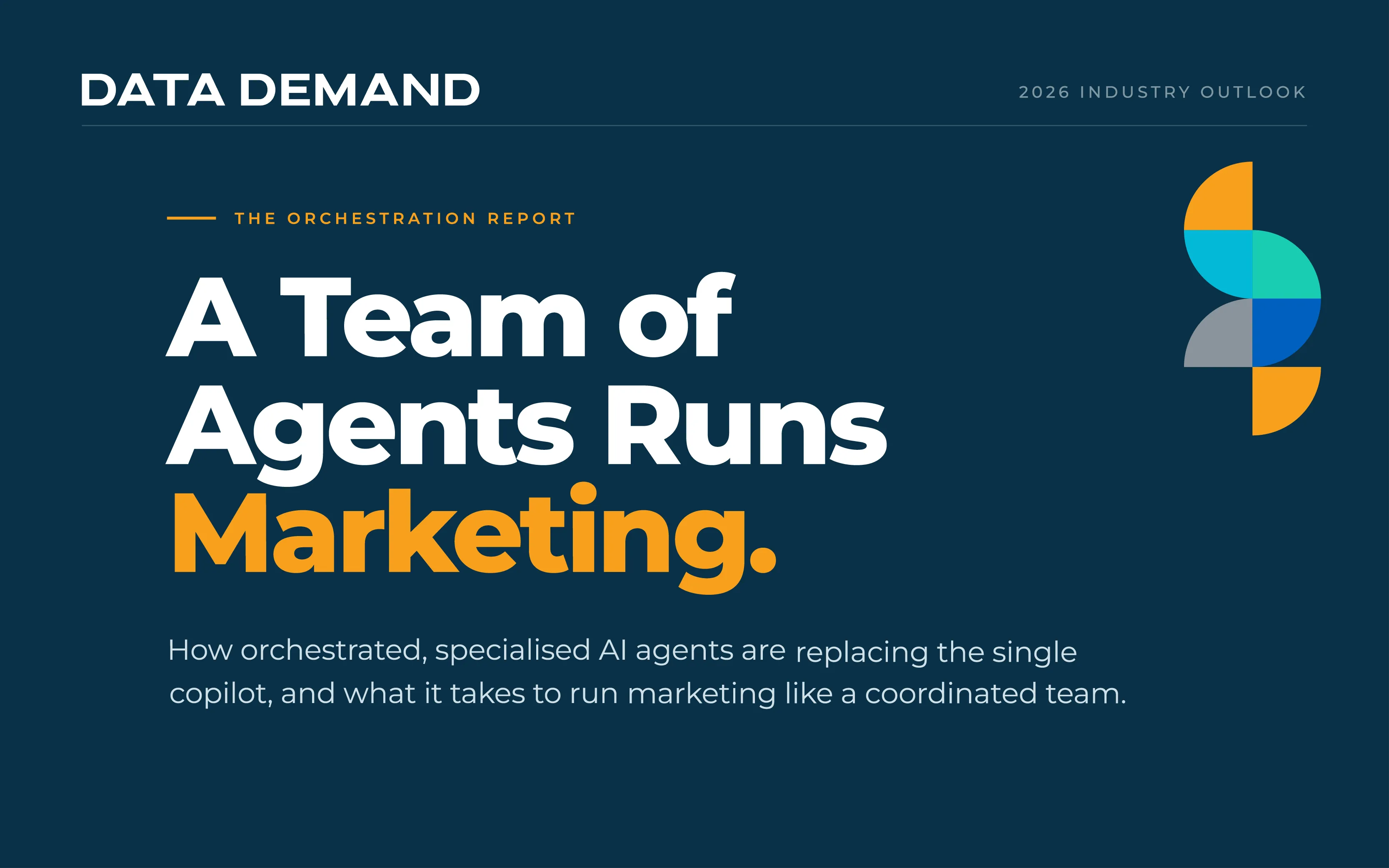
The A Team of Agents Running Marketing report by MarTech360 examines how marketing is moving beyond single AI copilots toward coordinated teams of specialised AI agents. It explores how this shift can help marketing teams increase execution capacity, coordinate complex workflows, and manage more campaigns without proportional headcount growth.
The report examines the five forces shaping multi-agent marketing: specialisation, orchestration, shared memory, evolving team structures, and governance. It explains why deploying individual AI agents is no longer the primary differentiator, and why the ability to coordinate them effectively will become increasingly important.
Inside the report, you will discover:
-
Approximately 90% of marketing teams are estimated to be running at least one AI agent in the report’s 2026 outlook.
-
Only 1 in 5 agent deployments is estimated to coordinate multiple agents as a team rather than operate individually.
-
Around 40% of defined marketing workflows could be managed end to end by a coordinated agent team, according to the report’s operating model.
-
A mature marketing agent team could include 6 to 8 specialised roles, supported by an orchestrator and shared memory.
-
Two in three leaders are assessed as being held back more by governance than by technological limitations.
The report explores why specialised agents can outperform a single general-purpose model when handling distinct marketing functions such as copywriting, media, analytics, and lifecycle marketing. It examines how an orchestration layer breaks down briefs, assigns tasks, manages dependencies, and assembles outputs, while shared memory keeps agents aligned with brand guidelines, customer data, and previous decisions.
It further examines how the marketing organisation chart could evolve as agents take on more execution. Rather than replacing human teams, agent systems can extend their capacity, allowing marketers to focus on strategy, judgment, relationships, and accountability.
The report also addresses the growing importance of governance as AI systems become more autonomous. It explains how clear objectives, brand and compliance guardrails, evaluation processes, audit trails, and escalation thresholds can help marketing leaders manage agent teams responsibly.
The report's five-principle playbook
The briefing provides a practical framework for building and managing an AI agent team. It recommends defining specialised agent roles, appointing an orchestrator, establishing shared memory, keeping humans responsible for oversight, and managing agent performance through continuous evaluation.
The 2027 outlook explores six developments to watch, including the emergence of agent operations as a function, more mature orchestration standards, continuous agent evaluation, agent marketplaces, stronger accountability requirements, and marketing output growing faster than headcount.