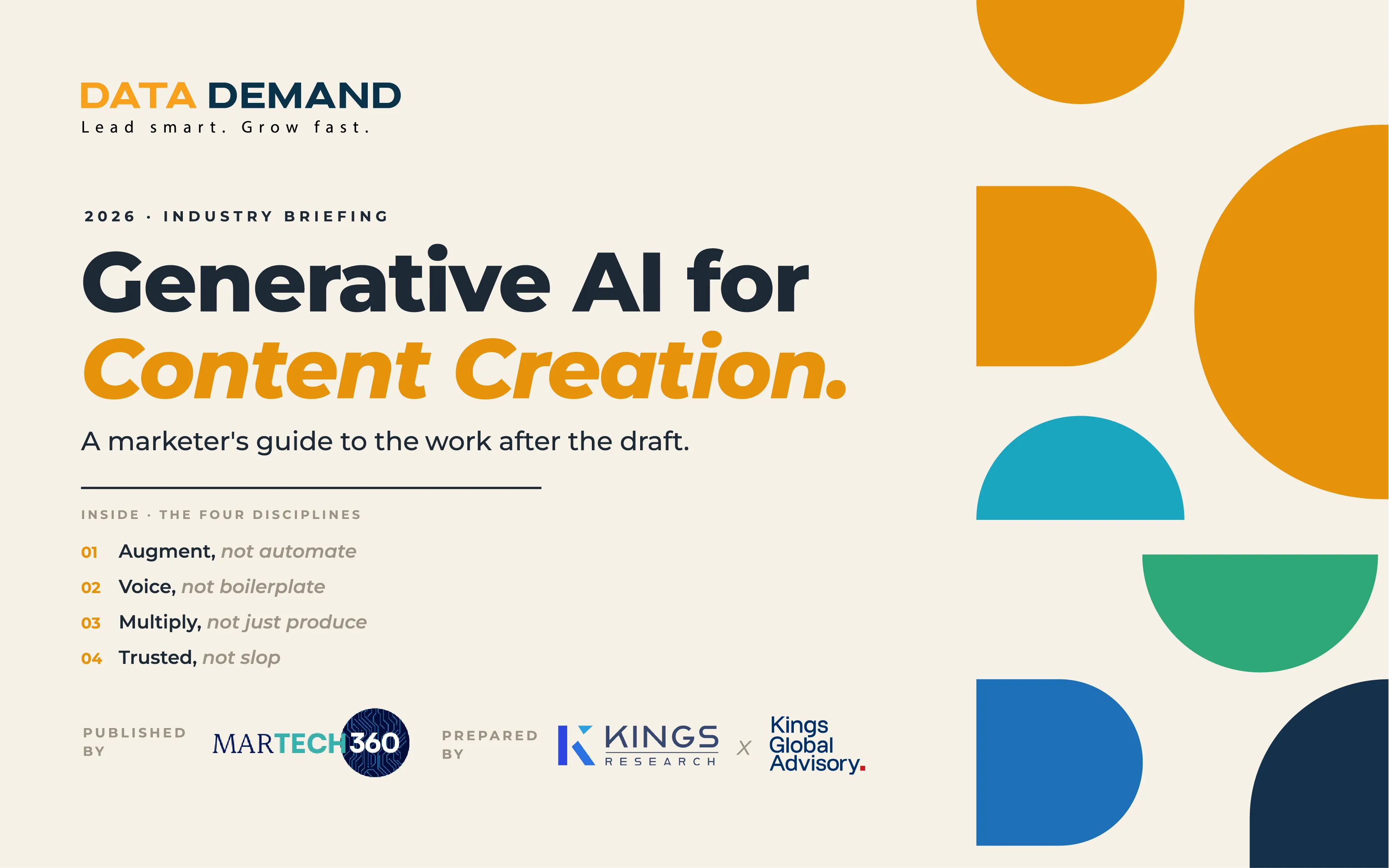
The Generative AI for Content Creation guide by MarTech360 examines what happens after AI generates the first draft. As generative AI becomes a standard part of marketing workflows, the report explores how marketers can use the technology without allowing speed and scale to turn content into generic, interchangeable output.
Based on industry research published across 2025 and early 2026, the guide explores the growing adoption of AI in content production, the productivity gains it delivers, and the growing importance of judgment, originality, brand voice and audience trust.
Inside the report, you will discover:
- 94% of marketers plan to use AI in their content creation process in 2026.
- Marketers save an average of 6.1 hours per week through AI tooling.
- Early adopters report a 30% to 50% reduction in content creation time.
- AI-assisted content drafting delivers an average reported ROI of 3.2X across marketing teams.
- 52% of consumers reduce engagement when they suspect content has been AI-generated.
- 43% of businesses cite concerns around AI content accuracy and bias.
The guide introduces four disciplines for using generative AI effectively: augmenting human creativity rather than fully automating it, grounding content in proprietary data and brand voice, multiplying strong ideas across formats and channels, and protecting output through accuracy, originality and disclosure.
It also provides a practical five-principle playbook for marketers, covering how to lead with an idea rather than a prompt, use proprietary inputs, reinvest AI-generated time savings into quality, build review into the workflow, and measure relevance rather than simply content volume.
The report concludes with an 18-month outlook covering originality as a competitive moat, greater AI disclosure, the growing importance of editing and strategy roles, multimodal content workflows, quality-focused search visibility, and more formal AI content governance.