
MarTech360 Interview with Tim Rodgers, CEO & Founder at Ace Workflow
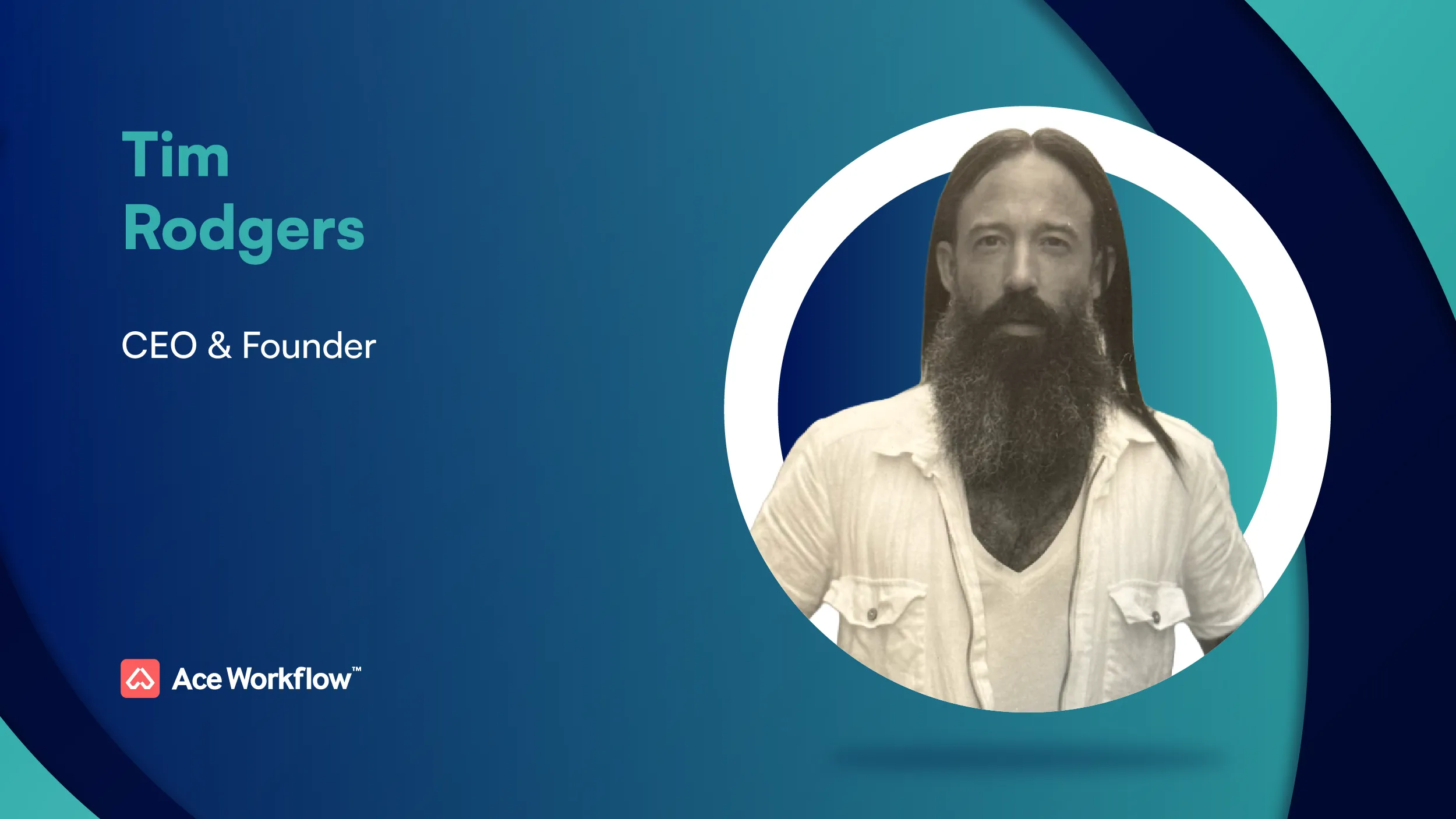

If you can take away the manual, the boring, the repetitive, the mind-numbing stuff that makes people dread work, you haven't only freed them up for more empowered work; you've made their day a bit better.
Tim, you've spent more than two decades at the intersection of creativity and technology, from building digital experiences for global brands to now rethinking how organizations work. Looking back, was there a particular moment when you realized the more interesting opportunity for technology might not be creating more, but removing the unnecessary work that gets in the way of people doing their best work?
I ran agencies for 20 years. Agencies are people businesses. You're selling time. There's a direct line between the hours you can sell and your revenue. So when you actually look at where the time goes, it gets uncomfortable fast. I was watching brilliant people, people who won us an Emmy and awards at Cannes, spend half their week copy and paste. None of that is billable, and none of it is what anyone was hired to do.
We hired creatives, strategists, and engineers. We didn't hire anyone to move data around. So I started building technology to fix it for my own teams, then for other people's, and eventually that became the whole business. It wasn't one dramatic moment. It was years of looking at where the week went and realizing talent was never the problem. The work was.
After going inside organizations and seeing how work actually moves, what has surprised you most about the kinds of work companies have quietly accepted as "just part of the job"?
The manual stuff. The sheer volume of it. You're talking about businesses that have been around 10, 15, 20 years, multinational companies that came up through an era of IT-controlled systems and enterprise software where nothing changed for a decade.
These are people who've been making do with out-of-date Microsoft Office products for years, filling every gap by hand. Excel is still the operating system for a lot of eight-figure operations. And here's the thing: it's not their fault. There was no other way to automate this stuff before. Either there was no budget for it or the technology genuinely didn't exist.
It's only in the past couple of years that the tech has aligned to where we can actually make a difference. So what surprised me most isn't that the manual work exists. It's how much of it there is, and how long smart people have been quietly carrying it because they had no alternative.
Manual data entry is 44% of all the work we document. It’s the single biggest problem in business.
Also Read: MarTech360 Interview with Anniston Ward, USA PR, Events, and Education Manager at Metricool
Ace's 2026 State of Work research looked at real processes across 128 companies and found that roughly a quarter of the mapped time was potentially recoverable, while half of all handoffs involved someone moving work from one screen to another. When you see that pattern repeatedly across organizations, what does it tell you about the way modern companies have actually been designed to work?
Building on the last answer. Companies are messy. The systems thinking exists, the smart operational thinking exists, but the delivery method for it is Excel and Google Docs. And the problem with those doc trackers is they leave the building with the person who built them.
Maybe it's a freelancer, maybe it's someone who quits, but that process walks out the door. Building custom systems is too expensive or too heavy a lift, so people settle for what they can make do with. The current climate of mergers, downsizing, and acquisitions only puts more chaos in the mix.
One of our clients has been through six reorgs in two years. Nobody there understands what work happens at the C-suite level anymore because it's been reorganized so many times. So it's reached a breaking point. And now companies are adding AI on top of all that, and employees are bewildered. How am I supposed to design the systems while doing the work?
That's the question sitting inside those numbers. Half of handoffs are human because a person was always the cheapest integration available.
The technology is now moving from copilots that assist people to agents that can execute work across systems. Yet organizations often seem less prepared than the technology itself. From what you've seen with clients, what is the hardest organizational problem to solve before an AI agent should be trusted with real work?
Bottom-up thinking. Too often these systems are built top-down, designed at a corporate or holding company level, and then teams are told to use them. I can think of a number of advertising holding groups that have taken that approach, and when you talk to the agencies and employees inside those groups, the tools that were created don't work for them.
They weren't designed for them.
So the hardest problem is understanding exactly what people actually do, and designing for that. Do that, and the governance question mostly answers itself, because the governance already exists inside the human process.
The hot take here is that humans and agents are interchangeable in a specific way: if you design a process for a person, that same process can be used to instruct an agent.
So we map the actual human processes, controls and all, accurately, and it becomes instantly transferable to an agent. What gets in the way isn't the technology. It's that most organizations don't understand how their own work actually happens.
There is a natural temptation to automate anything repetitive. Your approach seems more nuanced than that. How do you decide that a task should disappear, that a workflow should be redesigned, or that something is actually worth keeping human?
Clients often ask us to automate some elaborate, AI-heavy process that won't provide much actual value. It’s the wrong ask.
The real idea of automation is to build systems where work just flows, from one person, one team, one department to the next. In other words, automate the task, not the decision so the process is on rails, and humans come in to add judgment, taste, and experience.
When we're deciding what to touch, the obvious factors are time and frequency, but the one people miss is pain. What's the human element of this workflow that's just making people unhappy? If you can take away the manual, the boring, the repetitive, the mind-numbing stuff that makes people dread work, you haven't only freed them up for more empowered work; you've made their day a bit better.
And that goes a long way.
Your earlier career was spent creating technology that helped people experience brands in new ways. Today, you're building technology that removes friction from the way those people work. Has spending so much time on both sides changed your definition of what technology should ultimately do for people?
My definition has evolved. Working in creative technology, I thought tech should help people iterate. My creative process was built on hacking ideas, getting software to do stuff it wasn't designed to do, and using that to create advertising and marketing experiences.
Now I think technology should help people create value by removing all the copy and paste a machine can do. So people invest their time creating new ways to make the company stronger.
We now have an interesting paradox in AI. Individual employees are becoming more productive, while many companies are struggling to translate that productivity into meaningful business value. What do you think organizations misunderstand about the difference between making people faster and making the organization itself better?
They undervalue the power of people’s willingness to change and adopt. In some of our larger clients, the teams that outperform are more willing to experiment with AI. They create rather than adapt processes, and they generate proprietary datasets. This is playing out on the company level, too.
New companies that recognize the value in unique data and align teams on the mission are outmaneuvering much larger incumbents that drown teams in incremental change management.
The two-person AI telehealth GLP-1 weight-loss targeting $1.8 billion in revenue is the operating model, not an outlier.
You've worked with organizations ranging from creative and media companies to venture firms and large enterprises. After seeing so many different operating environments, what is the one form of "fake work" that seems almost universal, regardless of industry, and why do smart teams struggle to recognize it?
In our data, complaints about visibility outnumber complaints about speed almost five to one. Think about your own day. The number of times you're just trying to find information.
Where is the file? Has the order left the warehouse yet? Who do I call to get this signed off? What's the process for booking company travel?
Now actually add up the time it takes to get an answer, the number of other people you had to interrupt to ask, and the delay that caused to the thing you were trying to do in the first place.
That's the invisible fake work tax.
Even smart teams struggle to recognize it because no single question feels like waste. Asking a colleague where something is feels like collaboration. It's only when you total it up across a company that you see it for what it is.
Ace has evolved from hands-on workflow consulting toward building its own operational intelligence platform. Having learned from the consulting side first, what did working directly inside companies teach you that you would have struggled to discover by building the product first?
One of the biggest pains in any engagement, regardless of company size, is the consulting process itself. No one wants to sit in a meeting room discussing how they work for an afternoon.
You have to experience that to know it. Because we have four-plus years of operational maps, workflows, and software understanding from real engagements, we can create agents that understand the real pain points in a business, design the right solution, and keep learning through change where automation is actually making a difference.
If the promise of AI is not simply to make work faster but to give people back meaningful capacity, what do you think companies should be asking their people to do with that recovered time, and what would a genuinely better way of working look like to you?
We're doing a lot of work right now focusing companies around their OKRs and their value chain, understanding what the business actually needs to do to increase its value.
Then we map that into OKRs that point employees in the right direction once they have more time. Because it's not just "yey, we've got some free time, let's work harder."
It's about creating value for the business: OKRs can be easily modified, updated, and distributed to everyone in real time. So the recovered capacity goes toward value creation, and that value flows back to the employees.
A genuinely better way of working isn't about doing more work. It's about spending more time doing the work computers cannot do. Unfortunately, we've been treating our employees like software for too long.
That's the thing to fix.
Thanks Tim!
Tim Rodgers is an Emmy and Cannes Lions winning creative technologist and the founder of Ace Workflow, an operational intelligence company.
Ace finds the manual work draining a team, rebuilds it inside the tools that team already pays for, and then runs it. Four stages: Discover, Design, Build, Run. A team of 50+ forward deployed experts has delivered 311+ projects across more than 100 companies, including MasterClass, Warner, and Bessemer Venture Partners. As an Airtable Gold Partner, Ace builds human and AI workflows that cut errors by up to 95%, pay for themselves in weeks, and give people back 20+ hours a week for the work they were actually hired to do.
Before Ace, Tim led Rehab, the award-winning creative technology company, for two decades, building it into one of the world's most respected creative tech studios. His team created interactive and voice experiences for Disney, Google, Nike, Meta, HBO, and the Getty Museum, including the Emmy-winning Westworld interactive campaign and the AI-powered Stress Tester that predicted public reactions to Apple's "Crush" ad.
Recognized by Forbes, TechCrunch, AdAge, and ADWEEK, Tim is a frequent speaker and judge at Cannes Lions, D&AD, The One Show, and the Scandinavian AI Summit.
From his startup roots in Belfast to his base in New York, the mission stays the same: fix work, and build systems that make work feel human again.
