
MarTech360 Interview with Ada Mockute Jaime, Chief Marketing Officer at Nordcurrent

Everyone can create hundreds of variations, the question is no longer who can produce the most content. It is who understands what to test, who can recognise a meaningful signal and who can turn that learning into a better idea or a better product decision
Ada, your career has taken you from search and digital marketing to banking, customer value management, entrepreneurship, and now global gaming. Looking back, which experience most changed the way you think about what marketing is actually supposed to do for a business?
I do not think there was one big turning point. It was more a chain of events that gradually helped me connect all these separate dots. One important step came when I was working as Head of Business Development within a restaurant group. My role already combined product development, marketing, brand and communication; at one point, I was asked to work on the acquisition of a restaurant chain, and I realised that while I understood the marketing and product side, I knew very little about finance, mergers and acquisitions, or how to evaluate the wider business.
That led me to pursue my Executive MBA at the Stockholm School of Economics, where I started looking much more seriously at the overall P&L and at marketing as a financial function, not simply the department responsible for attractive advertising.
Today, I see marketing as the place where two very important sides of the business meet. It should build the brand, connect with people and communicate in a way that creates long-term relevance and longevity. But marketing is also often one of the largest areas of investment within a company. It therefore has to be deeply integrated into the financial strategy and clearly contribute to the value, growth and long-term direction of the business.
You’ve spoken about the importance of marketers understanding the wider business rather than staying within the boundaries of the marketing function. At Nordcurrent, where marketing sits so closely alongside product, player behavior and commercial performance, has that belief changed in practice compared with what you imagined when you first became a CMO?
It has become even stronger. In gaming, the distance between marketing, product and commercial performance is extremely short. You can bring millions of people into a game, but if the product does not give them a reason to stay, marketing cannot compensate for that. At the same time, marketing sees signals that can be incredibly valuable to the product teams. We see what players react to in advertising, what creators naturally choose to talk about, what appears in comments and what content people start producing themselves.
What changed for me is probably the speed and depth of that connection. In other industries, marketing can sometimes operate through quarterly plans and longer feedback cycles. In gaming, you are constantly looking at player behaviour, creative performance, retention, monetisation and LiveOps. The feedback is immediate.
It also means that a CMO cannot only understand brand and communications. You have to understand the product economy, acquisition, attribution, player behaviour and profitability. Otherwise, it is very difficult to make genuinely good marketing decisions.
Also Read: MarTech360 Interview with Dave Valliere, CEO & Founder at Form & Function Consulting
You spent several years working with customer value, data and intelligence in financial services before moving into gaming. In banking, long-term customer value is often expressed through retention, loyalty and economics. In gaming, those same ideas have to coexist with emotion, habit and entertainment. Has moving between those industries changed how you define customer value today?
I would actually say that moving from banking to gaming has not fundamentally changed how I define customer value. As a matter of fact, it has reinforced how similar the principle is across industries.
When I led a Customer Value Marketing department in banking, customer value did not mean only calculating how valuable a customer was to the bank. It was also about understanding what value the bank could create for the customer that would attract them, make the product relevant and give them a reason to stay.
Even banking, which appears to be a very rational category, is influenced by emotion. People are looking for safety, trust, convenience and a sense that their money is being looked after. The value offered by a bank is obviously very different from the entertainment, escape or enjoyment offered by a game, and gaming may express that emotional value more visibly. But the fundamental exchange is the same.
For me, customer value always works in both directions. It is the value the business receives from the customer, but equally the value the business creates for them. Marketing plays an important role in shaping that value proposition and sometimes even the product itself, finding the right angle and understanding which rational and emotional needs make the offer genuinely relevant.
Mobile gaming is increasingly shifting from a race for downloads toward deeper monetization and retention. Sensor Tower reported that global mobile game IAP revenue reached $82 billion in 2025 despite slowing download growth, while its Q2 2026 data showed gaming revenue declining even as Puzzle IAP revenue grew 17% year over year. From your perspective, what are the strongest signals that tell you a game is building durable player value rather than simply generating temporary acquisition?
The strongest signal is what happens after the initial acquisition effect disappears. Are players still returning? Do retention and engagement remain healthy across cohorts? Do they participate in events, come back after updates and respond to new content? Is monetisation supported by a broad and engaged player base, or is performance dependent on a small number of users or one particularly successful campaign?
I also look at the relationship between paid and organic behaviour. If a game is building durable value, you usually start seeing players searching for it, recommending it, creating content and discussing it without being asked. Creators can be especially revealing here because they quickly show us which parts of a game are genuinely entertaining and culturally relevant.
Short-term acquisition can make almost any product look successful for a period of time if enough money is spent. Durable growth is different. It means the product continues to resonate, cohorts remain economically healthy and marketing becomes an accelerator of existing player interest, rather than the only force keeping the game visible.
You’ve spoken about UGC as more than a marketing channel, because player-created content can reveal what audiences are actually responding to. As brands increasingly work with creators, do you think the more valuable shift is from treating creators as campaign partners to treating them as community builders and an ongoing source of customer intelligence?
Absolutely. I think the traditional campaign model captures only a small part of what creators can contribute. If you work with a creator once, give them a script and measure the views, you are mostly renting their reach. If you build a longer relationship, they can become part of the community around the game.
Creators spend an extraordinary amount of time with audiences. They see which jokes land, which features create frustration, what players want to discuss and which parts of the game naturally become content. That is valuable customer intelligence, but only if the company is prepared to listen and create a feedback loop rather than treating creators as another media placement.
This is why we work with creators of very different sizes and formats. Some may not have enormous audiences, but they understand the community incredibly well. The relationship also has to work both ways. We need to give creators access, tools, recognition and room to create in their own voice. Otherwise, we remove the authenticity that made them valuable in the first place.
Follower count has traditionally been one of the easiest ways for brands to judge creator influence, but gaming communities can form around creators whose audiences are much smaller and far more engaged. When you evaluate whether a creator can genuinely move a player community, what signals matter to you beyond the size of their audience?
I look at whether people genuinely pay attention to them. That is visible in the quality of the comments, repeat viewers, live interaction and whether the audience responds when the creator asks them to do something. A smaller creator who can start a conversation, bring players into a game or make them return can be much more valuable than someone with a very large but passive audience.
Consistency also matters. I want to understand whether the creator has built trust over time and whether their audience follows them because of a real point of view. Audience fit is equally important. A creator may have excellent engagement, but if the game feels completely unnatural within their content, the partnership will still struggle.
Finally, I also look at creative instinct. Some creators understand how to turn a game mechanic, character or small player moment into content that feels native to their platform. That ability is difficult to measure through follower count, but it can have a very strong impact. Real influence is not simply being seen. It is being able to generate attention, participation and action.
AI is making it possible for gaming marketers to produce and test creative variations at a scale that would have been difficult to imagine a few years ago, and Nordcurrent is now building generative AI directly into its marketing workflow. As creative production becomes cheaper and faster, where do you think the real competitive advantage moves next, and what should marketers be careful not to lose in the process?
I think the advantage moves from production capacity to judgement. When everyone can create hundreds of variations, the question is no longer who can produce the most content. It is who understands what to test, who can recognise a meaningful signal and who can turn that learning into a better idea or a better product decision.
AI gives us speed. It allows teams to explore concepts, formats and local variations that would previously have taken much more time and budget. But speed is only valuable if it helps us learn. Producing more average content is not a competitive advantage.
The risk is that brands lose their taste, distinctiveness and understanding of real people. If everybody uses similar tools, inputs and trends, creative work can very quickly start to look the same. We should also be careful not to remove cultural nuance and human emotion from the process. AI can accelerate execution, but marketers still need curiosity, judgement and empathy. The strongest teams will combine machine-enabled scale with very human creative direction.
As acquisition costs rise, privacy changes make targeting and measurement more complex, and players divide their attention across more platforms and communities, retention becomes increasingly important. But retention cannot be solved by marketing alone. How do you see the relationship between marketing, product and LiveOps changing when the real objective is not simply to win a player, but to keep earning their attention?
It has to become much less of a handover. The old model, where product creates something and marketing is then asked to promote it, is not enough. Marketing, product and LiveOps need to work around a shared understanding of the player and shared commercial objectives.
LiveOps gives players reasons to return. Product has to make sure the experience remains enjoyable and rewarding. Marketing brings in external signals, helps frame those moments and connects them with the right audiences. But all three functions should be learning from the same behaviour.
For example, if a particular character, location or mechanic consistently performs well in advertising and creator content, that insight should not stay contained within the marketing team. Equally, marketing needs to understand the product roadmap and the player experience deeply enough to avoid promising something the game does not deliver.
In short, retention is not a marketing metric or a product metric. It is the result of the entire experience. Keeping attention means repeatedly proving to players that returning is worth their time.
Nordcurrent’s creator network works with creators of different sizes and formats, while your broader work also touches on making brand partnerships feel native to the audience experience. What makes a creator or brand partnership genuinely valuable in gaming, rather than something that simply places a brand in front of players?
A good partnership should add something to the player experience. If the only idea is to place a logo somewhere visible, players will recognise that immediately. The partnership needs a reason to exist inside that particular game, for that particular audience.
The best integrations create something people can play with, collect, discuss or use for self-expression. For example, a fashion partnership in Pocket Styler can feel natural because fashion is already central to the player experience. A food brand within a cooking game can become part of the gameplay or content rather than interrupting it.
The same principle applies to creators. Their personality and format should shape the collaboration. If we remove their voice and make them communicate like the brand, we lose the reason their community trusted them.
Commercial reach still matters, of course, but relevance matters more. A valuable partnership should create a benefit for all three sides: the player gets a better or more interesting experience, the partner enters the culture naturally and the game gains attention, engagement or long-term value.
You’ve worked across industries, built a company yourself, served at board level, and now lead marketing for games played by hundreds of millions of people. When you look at where marketing is heading, what is one assumption about customers, growth or brand building that your career has made you question most deeply?
Probably the assumption that growth can be created mainly by increasing reach and spending more money. My career has taught me that marketing can amplify demand, but it cannot manufacture a strong and sustainable relationship with a product that does not resonate.
This has become especially clear in gaming. A large number of downloads can look impressive, but it does not automatically mean you have built a successful business. You need product-market fit, healthy retention and a clear understanding of why people choose to return. Only then can marketing really accelerate growth.
I have also questioned the idea that customers are simply an audience waiting to be persuaded. People now participate in brands. They create content, form communities, reinterpret products and influence how other customers see them. That means some of the most valuable marketing is not created entirely by the company.
The role of marketing is increasingly to listen, recognise what is already resonating and build the conditions in which customers, creators and communities want to carry the story further.
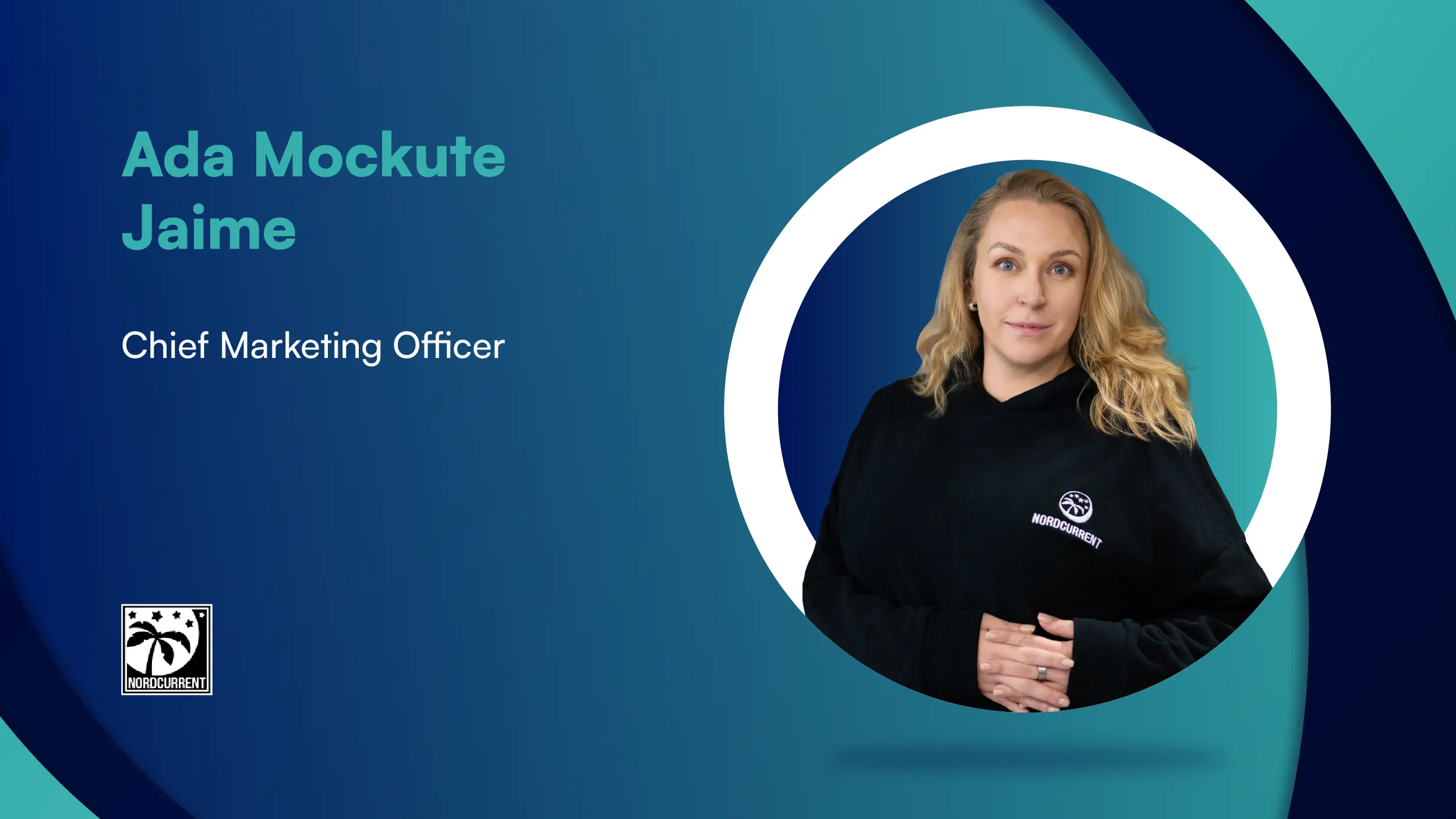
Ada Mockute Jaime is a commercially minded marketing leader with experience spanning digital marketing, customer value, business development, and gaming. As CMO at Nordcurrent, she brings a broader view of marketing that connects brand, customer behavior, product performance, and business growth.
Her approach places strong emphasis on customer value, creator communities, UGC, retention, and data-driven decision-making. She also views AI as a tool to accelerate creative execution while stressing the importance of human judgment, authenticity, and empathy.
