
MarTech360 Interview with Rafa Flores, Chief Product & Growth Officer at Treasure AI
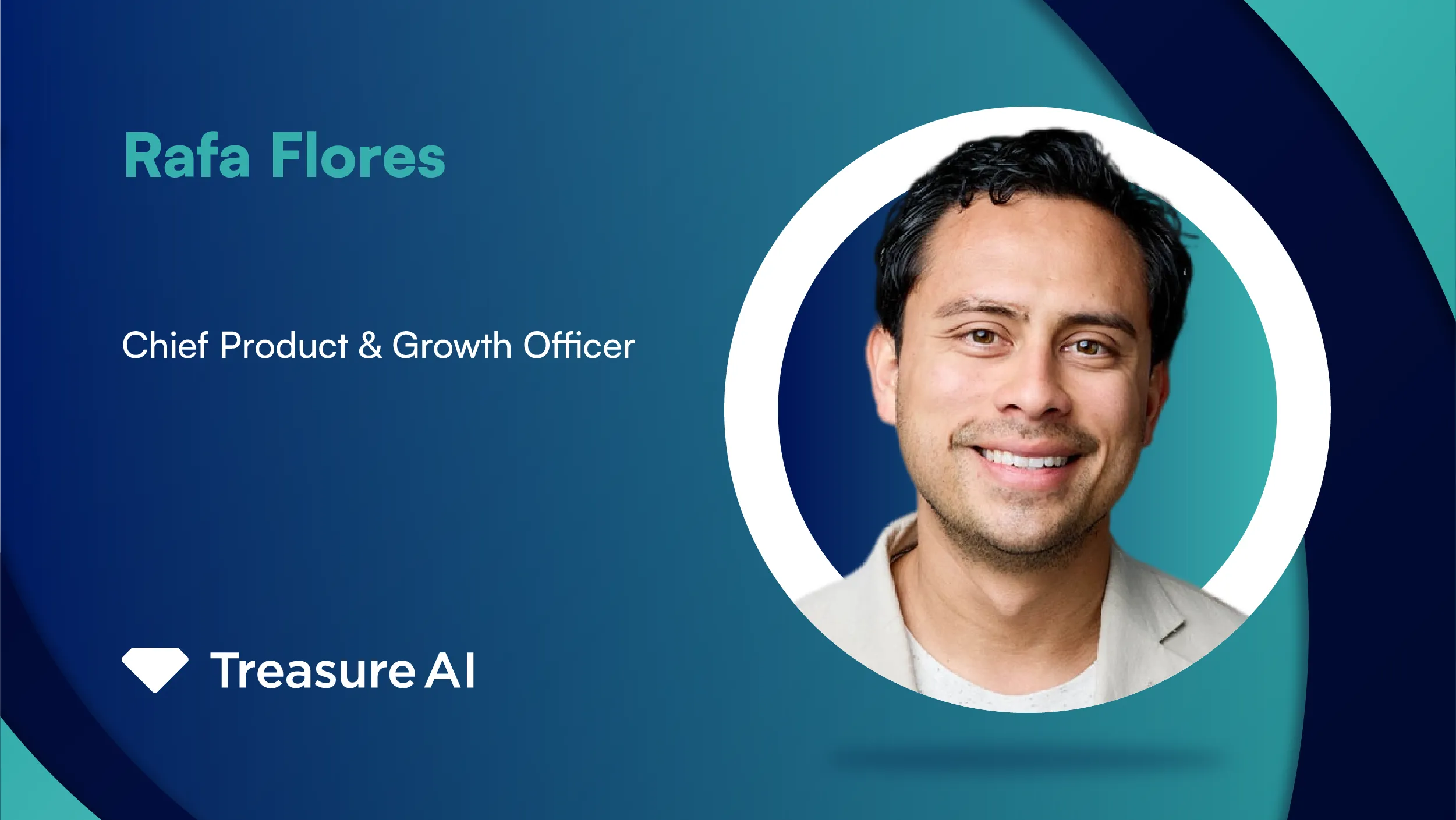

“AI is a tool you're in control of. Use it wisely, keep it governed and secure, and own it.”
What early experience still shapes how you decide which problems are truly worth solving?
I immigrated to the United States at a young age and grew up navigating limited resources, personal loss, and uncertainty. Those experiences shaped a mindset that still defines how I lead a product today: lean into challenges, create a clear path forward, and don’t lose the joy of building along the way.
Before we commit to a problem, I ask three questions. Is someone feeling this pain every day, not just in a demo? Can we measure the outcome in the customer's terms, like revenue, retention, or cost, rather than ours? And does solving it make the next problem easier to solve?
The third question matters more than people expect. The best problems compound. As we spent the last 15 years unifying customer data as a Customer Data Platform, that wasn't just a data problem. It became the foundation that made predictive AI,, and now Agentic AI, possible. The best problems worth solving are those that lead to lasting platforms.
What did seeing Treasure AI from the outside teach you about the opportunity that brought you back?
When you build something from the inside, you don’t always see every limitation. It’s almost as if you are so close to the product that you can’t see the forest through the trees.
When I left Treasure Data (now Treasure AI), I joined other tech companies but saw the same problems arise at both: companies had plenty of data and tools but no single trusted view of the customer to act on. With this new, outside perspective, I could look back on what Treasure Data had created and see more clearly its potential. I realized the hardest part of what we'd built at Treasure Data, unifying and resolving customer identity at enterprise scale, was exactly what AI was going to need. Models were getting cheap and powerful fast, but trusted customer context wasn’t.
Coming back in 2025 with that context gave me the direction to move fast. The foundation was already there and I saw the opportunity was to build the AI layer directly on top of it. Our tagline at Treasure AI is “move at the speed of now,” and I can truly say that upon my return to the company, we learned how to fail fast, fix fast, and then move even faster.
Also Read: MarTech360 Interview with Dominic Leung, Executive Director of Strategy and Transformation at Monigle
What did 6sense teach you about the difference between better intelligence and turning it into action?
It taught me that insight is the starting line and there’s lots to go from there.
Predictive AI is great at telling you which accounts are in market or which customers are likely to churn. But a score sitting in a dashboard doesn't do anything. Someone still has to notice it, interpret it, decide what to do, and then execute across several systems. Every handoff is a place where value leaks out.
Generative AI closed part of that gap, because it could draft the email or summarize the account, but it still mostly assisted a person who had to carry the work forward.
The lesson I brought to Treasure AI is that the real value sits in closing the loop. You have to have intelligence, decision, action, and then learn from the result. And of course, we always stress the human in the loop. AI needs adult supervision, and we as humans need to understand, confirm and act on the intelligence AI is giving us. We need to give humans the tools to not only gain insight, prediction and recommendation but then close the loop with the next best step.
What changes when customer data moves from helping marketers understand customers to helping AI decide and act?
The tolerance for error changes completely.
When a marketer uses data to understand customers, a human sits between the data and the outcome. If a segment is a little off, a person usually catches it. When an AI agent acts on that same data, there's no one standing in that gap. A duplicate profile or a stale attribute stops being a reporting nuisance and becomes a wrong offer sent to a real customer.
So three things have to change. 1. Data has to be accurate at the moment of action. 2. Governance has to travel with the data, so an agent inherits the same consent rules and access controls a human user would. 3. The system has to record what the agent did and why, so people can review it and improve it.
In short, customer data used to be a reference library and now it's an operating system. That's the shift behind Treasure AI and our Agentic Experience Platform.
What makes customer context genuinely useful to an AI system rather than simply giving it more data?
More data often makes AI worse, not better. If you hand an agent five conflicting versions of the same customer, it will confidently pick the wrong one
Useful context means the agent knows these ten records are one person. It's also current, reflecting what the customer did an hour ago, rather than last quarter. It's governed, carrying consent and access rules with it. And it's relevant, shaped to the decision at hand.
That's the job of the Diamond Record, our Intelligent Customer Data Platform. It's a single, trusted source of truth for each customer that works across every ID graph and system in a company's stack. Our AI Agent Foundry is built directly on top of it, so every agent starts from the same accurate profile and the same access controls.
AI has a data blind spot, but so do people. Thankfully, we can engineer the context an agent sees.
What are enterprises beginning to understand about the data foundation required before AI can act with confidence?
They're realizing that the model is the easy part. You can create an impressive agent in an afternoon, but trusting it with your customers is a different matter.
The companies moving fastest now treat data unification as step one, not cleanup for later. Nestlé is a good example. They unified fragmented data across business units in Mexico and Brazil, and that foundation is what let them reach more than nine million people with a 140% lift in engagement and a 49% lower cost per lead.
What will determine which decisions leaders are comfortable handing over to agents?
Three things: reversibility, volume, and evidence.
Reversibility comes first. If a decision is easy to undo, like which subject line to test or when to send a reminder, leaders will hand it over quickly. If it's hard to undo, like pricing, a sensitive customer message, or anything touching brand voice, a person stays in the loop.
Volume is second. Agents earn their keep on decisions that happen thousands of times a day, where no team could ever give each one individual attention. That's where one-to-one personalization finally becomes economical.
Evidence is third, and it's the one that moves the line over time. Trust comes from a good track record instead of hype or capability. When an agent performs well inside clear guardrails, with every action logged and reviewable, leaders can widen the boundary. If AI has proven that it can handle a decision, leaders can loosen the grip more.
AI is the muscle, and humans are the mind and the heart. People set direction, own judgment, and decide how the brand makes customers feel. That isn’t ever going away — and humans will always stay in the loop.
How has the broader mandate changed the way you define product success?
Early AI programs chase operational efficiency, saving a few hours here and there. That matters, but the bigger prize is business results. When the product team owns growth, you can't hide behind capability. You have to prove it.
I never promote people based on the amount of work they do or the hours they put in. People get promoted if they are adding value and driving outcomes for their team. That’s the scorecard we are giving ourselves as an AI company and even relates to the pricing changes we’ve implemented at Agentic World this past week. Instead of charging our customers based on the numbers of emails sent through our platform - like we did in the days of SaaS - we will only charge if those emails get a 2% open rate. The point we’re making is that first, we believe in our Agentic Experience Platform so much that we’re willing to bet on it. And two, in the age of AI, our focus should be less on what tasks we complete and more so on what outcomes we create.
Cox Automotive is a great example of this. In our panel together at Adweek’s Brandweek, Callie Cogley, consumer data strategy director at Cox Automotive shared how important it is for companies to understand their “why” when innovating with AI. Understanding your why will allow you to redefine an outcome-based scorecard that’s supported by Agentic AI.
Will the next generation of martech be more platform-driven, more agent-driven, or both?
Both, and they need each other.
Agents will absorb much of the work that used to require a dozen point tools. Building a segment, drafting a campaign, setting up a journey, analyzing the results: an agent can carry that work from one step to the next through a single conversation. That's going to compress the martech stack considerably. Many tools that exist mainly to move work between people will struggle.
But agents can't run on air. They need a shared foundation of trusted customer data, identity, consent, and governance underneath them. Without that, you'd just have a dozen agents each working from its own partial view of the customer, which recreates the fragmentation we're trying to escape.
So I see the stack consolidating into three layers. There's a platform layer that holds the customer truth and the guardrails, and an agent layer that does the work on top of it. Which agents you run will change constantly so it’s the platform that lasts. And thirdly, the human in the loop is the final and most important layer. None of this can happen without the marketers driving the machine.
What is one assumption about AI-powered products the industry may be getting wrong?
That the main goal is to remove humans from the loop.
A lot of the market is racing toward full autonomy as if that were the finish line. I think that's the wrong target. The goal is not to take people’s jobs; I want to help to stop wasting people on the work between decisions so they can spend their time on the decisions themselves.
We learned this firsthand building Treasure Code, which was built by one engineer using Claude Code. AI writes a lot of our code now, but our rule is that AI writes code and AI does not ship code. There's an AI reviewer, standard testing, and a human sign-off every time. This is the sweet spot we’ve found that we can move fast without breaking trust.
The products that win won't be the ones that remove the most people. They'll be the ones that make people dramatically more capable, inside guardrails they can see and control. AI is a tool you're in control of. Use it wisely, keep it governed and secure, and own it.
Thanks Rafa!
Rafa Flores is a product and technology executive with experience spanning AI, enterprise SaaS, customer data platforms, and product-led growth. As Chief Product & Growth Officer at Treasure AI, he leads product strategy and growth initiatives, focusing on AI-powered customer data capabilities, intelligent marketing, and enterprise AI adoption. His previous leadership roles at 6sense and earlier experience at Treasure Data have involved developing and scaling data-driven products, predictive AI capabilities, and enterprise software platforms. Flores focuses on connecting product innovation with customer needs and measurable business outcomes, with particular interest in how AI agents, automation, and unified customer data are reshaping marketing technology and enterprise decision-making.
