
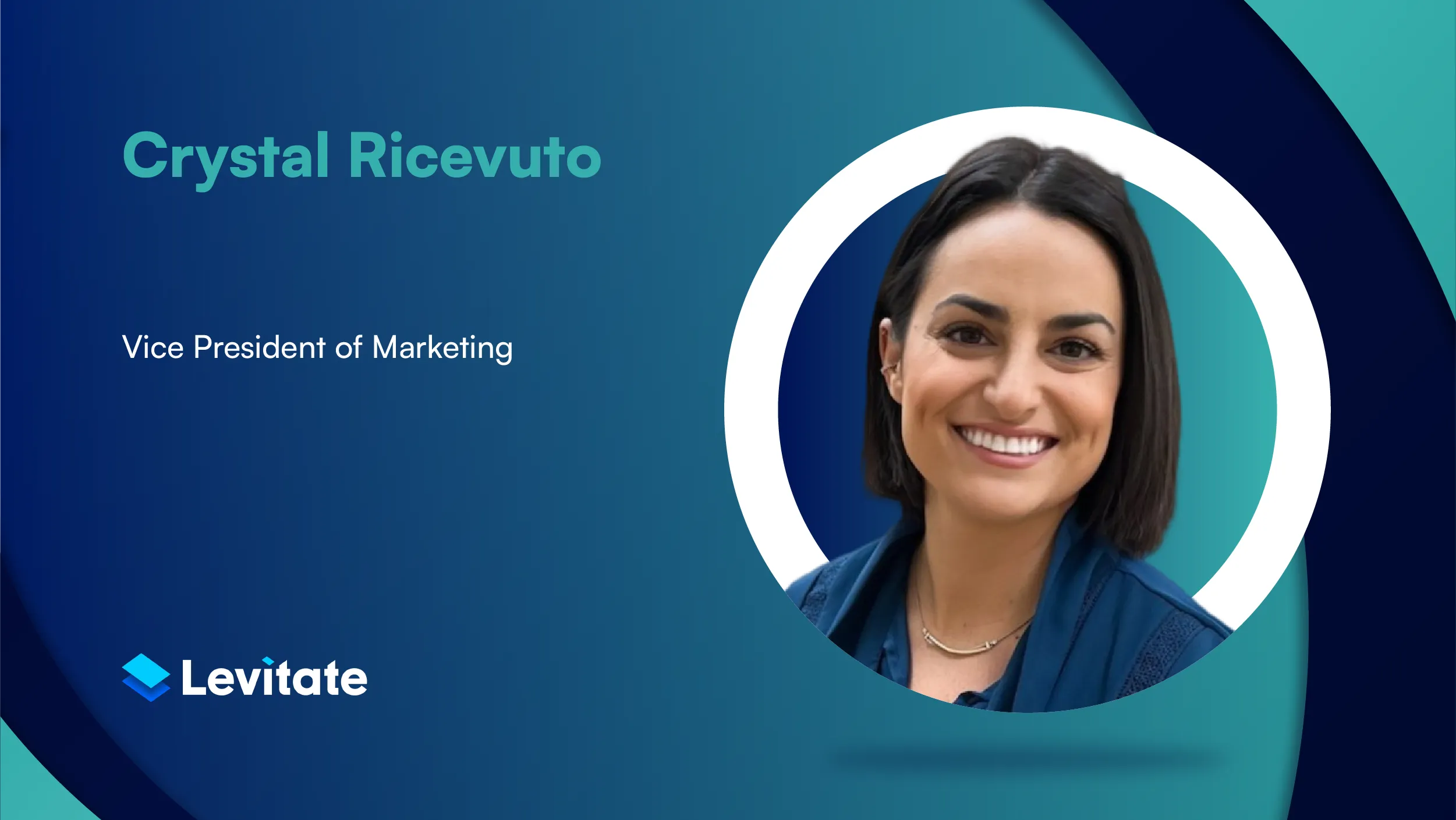
MarTech360 Interview with Crystal Ricevuto, Vice President of Marketing at Levitate

"AI can remind you to ask, and it can help you write the note, but the curiosity, listening and genuine interest in another person still have to come from you. I think that's only going to matter more as AI takes on more of the work around it."
Crystal, your career has moved from customer care and sales engineering to product management, partnerships, and now marketing leadership at Levitate. What experience along that journey most changed how you understand what customers actually need from technology?
I've been lucky to see the customer from almost every seat: customer care, sales engineering, product, partnerships, and now marketing. I've also gone from SMB to enterprise and back to SMB. Across all of it, the lesson is the same: everyone wants it to be easy, and everyone wants it to just work. I've worked with three-person businesses and Fortune 500 companies, and honestly, nobody has patience for software that's harder than it needs to be.
I started in customer care, and it taught me the lesson I've carried into every role since: the customers who trust you most aren't the ones who never had a problem. They're the ones you got ahead of. When you anticipate a concern they hadn't even considered yet, you earn trust, and trust is the whole game. At every size, customers are really buying confidence that you'll take care of them.
You spent years on the product and customer side before moving into marketing. How has that experience shaped the way you decide which parts of a product story deserve attention, and which complexity should remain invisible to the customer?
This might be a hot take, but I think a marketing leader should know the product inside and out. For me, that comes from my years in sales engineering, where I learned to demo. I still hold myself to that bar: I should be able to position our use cases as well as anyone on our sales team. If marketing can't tell the story in a live demo, we can't expect it to land in an ad or an email.
Product taught me that the story isn't the feature list. It's the moment a feature matters to a specific customer. For a home services company, it's being the first name a homeowner thinks of when the AC goes out. For a real estate agent, it's how fast they can get a market update out. For a nonprofit, it's results they can show their board. Knowing the product deeply is what lets me pick the right story for each audience.
As for complexity, it should never be the customer's problem. We want customers to understand what they're using, but getting value from it shouldn't be hard. Our job is to absorb the complexity so the learning curve feels like a ramp, not a wall.
Also Read: MarTech360 Interview with Marc Hutchinson, Vice President, Solution Architecture at TTEC Digital
Levitate built its approach around helping businesses stay meaningfully connected rather than simply sending more marketing. As AI makes personalized communication easier to produce at scale, what do businesses risk misunderstanding about what it means to stay genuinely top of mind?
They think more is better. AI makes it easy to send more, and inboxes are already pushing back, with AI filtering and summaries deciding what actually gets seen. I still talk to businesses whose main outreach is a templated mass newsletter, and they ask me how to keep AI from marking them as spam. My answer: you can't, and you shouldn't want to. AI also makes it easier than ever to send something worth opening.
To be clear, I don't expect a personal email from the CEO of J.Crew about their new cashmere sweater line. But I do expect my financial advisor to reach out when I get a promotion, and it's a missed opportunity if they don't. People do business with people they like, and with people who see them as more than just a book of business.
Staying genuinely top of mind is small acts of attention. Like a note when severe weather hits a client's hometown. A quick "I saw the news about the earthquake in Colombia. I hope your family is okay. We're thinking of you." That isn't marketing volume. That's a relationship. AI should help a small business act like the best version of a careful relationship manager, not a bigger blast engine.
In your thinking around ‘Authentic AI,’ you have emphasized saving time without losing personality. As AI becomes increasingly capable of producing polished, personalized communication, what will ultimately distinguish something that feels genuinely human from something that merely looks personalized?
Whether it could only have come from you. AI can make anything look personalized: drop in a first name, a city, a job title. That isn't the same as personal.
What feels human is specificity that comes from an actual relationship. Remembering a client's daughter just started college. Knowing they were nervous about rates last spring and checking in when things changed. It also has to sound like you. If every advisor's email has the same polished, slightly breathless AI tone, none of them stand out. That's the AI slop everyone is tired of.
Here's the test I use: if you replaced the recipient's name with someone else's, would the message still make sense? If it would, it's personalized. If it wouldn't, it's personal. Our Authentic AI approach lets AI do the heavy lifting (drafting, timing, remembering) while the person keeps the judgment and the voice. AI should save you time, not replace your personality. The person on the other end should feel known, not automated.
Levitate now serves more than 8,000 businesses while expanding across AI, websites, social, reviews, surveys, and relationship intelligence. As the platform becomes more capable, how do you preserve the simplicity that originally made the proposition resonate with relationship-driven businesses?
I've been at Levitate for almost seven years, and the product has grown so much in that time. But the reason customers come to us hasn't changed. From the very beginning, the idea was to help relationship-based businesses keep in touch authentically as they grow, without it turning into a second job. So everything new we build has to pass that test.
AI is actually what's helping us keep it simple. Customers can set up automations and segments just by describing what they want in plain language, instead of having to learn how to build them. It's also making it easier to connect the different parts of the platform, so it feels like one tool and not a bundle of features. The more capable we get, the less our customers should have to think about it.
You have described Levitate’s ‘Service-as-Software’ approach as going beyond simply giving small businesses another platform. What have you learned about the difference between giving customers more capabilities and actually making their marketing work meaningfully easier?
A large company has designers and copywriters on payroll. A three-person accounting firm doesn't, yet we expect it to wear every hat a 100-person company does. What I've learned is that for a business like that, more capabilities can actually make marketing harder. Every new feature is one more thing a busy owner has to learn, set up and remember to use.
It’s not a small problem. Small businesses pay for software all the time that they never fully use. Not because they don’t want to use it, but because they don’t have time to become an expert in every tool they buy. We can’t just hand someone a login and a library of help articles and wish them luck. Even the motivated customers lose momentum when the burden is still on them to figure everything out.
Service-as-Software is essentially agency-light. We write the content, build the graphics, match their brand and voice, explain the concepts that didn't exist 20 years ago (hello AEO and GEO), and help them actually do it. We take the same approach with AI. Anyone could build some of what we're releasing, but it might take them 30 or 100 hours, and they'd be the one fixing it when it breaks. We make it turnkey and keep improving it so they don't have to.
Levitate’s newer AI capabilities are moving beyond content generation toward identifying who may be worth reconnecting with and why. Does this point to a broader shift in marketing automation, from automating tasks to helping businesses decide where human attention matters most?
Yes! I love these new capabilities, because they're really what we set out to build from the beginning. Back in 2017, AI was already part of the vision: helping businesses figure out who to keep in touch with, and eventually helping them write the message. The tech just wasn't there yet, so we built what we could with vertical-specific content, thoughtful workflows and human writers, and that's what earned the trust of thousands of small businesses. Now the technology has finally caught up to the original idea, which was always less marketing, not more. Quality over quantity is what makes the impact. Anyone in marketing knows only a small share of your audience is in the market at any given moment. The perfectly timed email, or even a text when it's appropriate, is worth far more than pummeling people with noise.
Marketing automation spent 20 years helping companies send more. The next decade is about sending less, but better. That means telling you who to reach out to, when, and why. Say a client just bought a new home, or it's been months since you talked to someone who used to send you referrals. The platform flags it, suggests a note, and you decide what goes out. Automation handles the remembering and the timing, and the human shows up when it counts. Don't let people forget you, but don't give them a reason to tune you out either.
You recently expanded Levitate’s brand-building efforts through CTV and YouTube while the company continues investing in AI and revenue marketing. As execution becomes easier through AI, what are you learning about the role brand still plays in creating durable differentiation?
Brand actually matters more now, not less. When anyone can produce slick content, what's hard to copy is a story people actually feel.
Ironically, our CTV and YouTube campaign wouldn't have happened without AI. I used AI to build a mock version of the commercial concept for pennies. It let our leadership and board see the idea, a story any small business owner could relate to, before we spent real money. Only then did we commit to a full production we're really proud of. And the final ad isn't AI.
That's the lesson. AI is a phenomenal tool for testing ideas and getting buy-in fast, but the brand itself, the emotion and the craft, still comes from people. AI made it much cheaper to test the idea before we committed real money to it, which gave us more room to take a creative swing.
Your earlier work in business development and partnerships included integrations with platforms such as Clio and Wealthbox. What did that experience teach you about where the real value of a SaaS product is created when it must fit naturally into customers’ existing workflows?
That the value lives where the customer already works. When we first started building our integrations, they were a differentiator. Today they're table stakes. The bar isn't "do you integrate" anymore. It's whether your product feels like part of their system or one more tab they have to remember to open.
It's not that people are lazy. They're busy. Every extra login, export or copy-paste is friction, and friction compounds. Eventually a follow-up falls through and someone gets burned. The best integrations are the ones customers stop noticing because the work just flows. That's where a SaaS product earns its place: in how naturally it fits into someone's day.
You have watched Levitate evolve from relationship marketing into a broader AI-powered platform. As AI takes more repetitive work away from marketers, what capability do you think will become more valuable for the humans still responsible for building meaningful customer relationships?
Knowing people. As AI takes on repetitive work, you might end up with more work, or you might finally have time to enjoy your life. Ideally it's the second. Either way, the best use of the time AI gives back is talking to people.
I see it in my own work. When AI takes the first pass at drafts, research and reporting, I get that time back for conversations with customers and the people I work with.
Relationships run on details only humans collect. You can't ask a client about little Bobby's soccer league if you never took the time to build rapport in the first place. AI can remind you to ask, and it can help you write the note, but the curiosity, listening and genuine interest in another person still have to come from you. I think that's only going to matter more as AI takes on more of the work around it.
Thanks Crystal!
Crystal Ricevuto is a marketing executive with experience across SaaS, technology, brand strategy, and revenue-focused marketing. As Vice President of Marketing at Levitate, she oversees marketing initiatives spanning inbound growth, brand awareness, relationship marketing, and AI-driven marketing strategies. Her career at Levitate has included roles in business development and marketing, giving her experience across both revenue generation and broader marketing strategy. She has also been involved in building the company's brand and expanding its marketing presence, including campaigns across CTV, YouTube, and other channels. Her professional focus reflects an approach that combines data and revenue accountability with brand storytelling, customer relationships, and emerging marketing technologies.
