
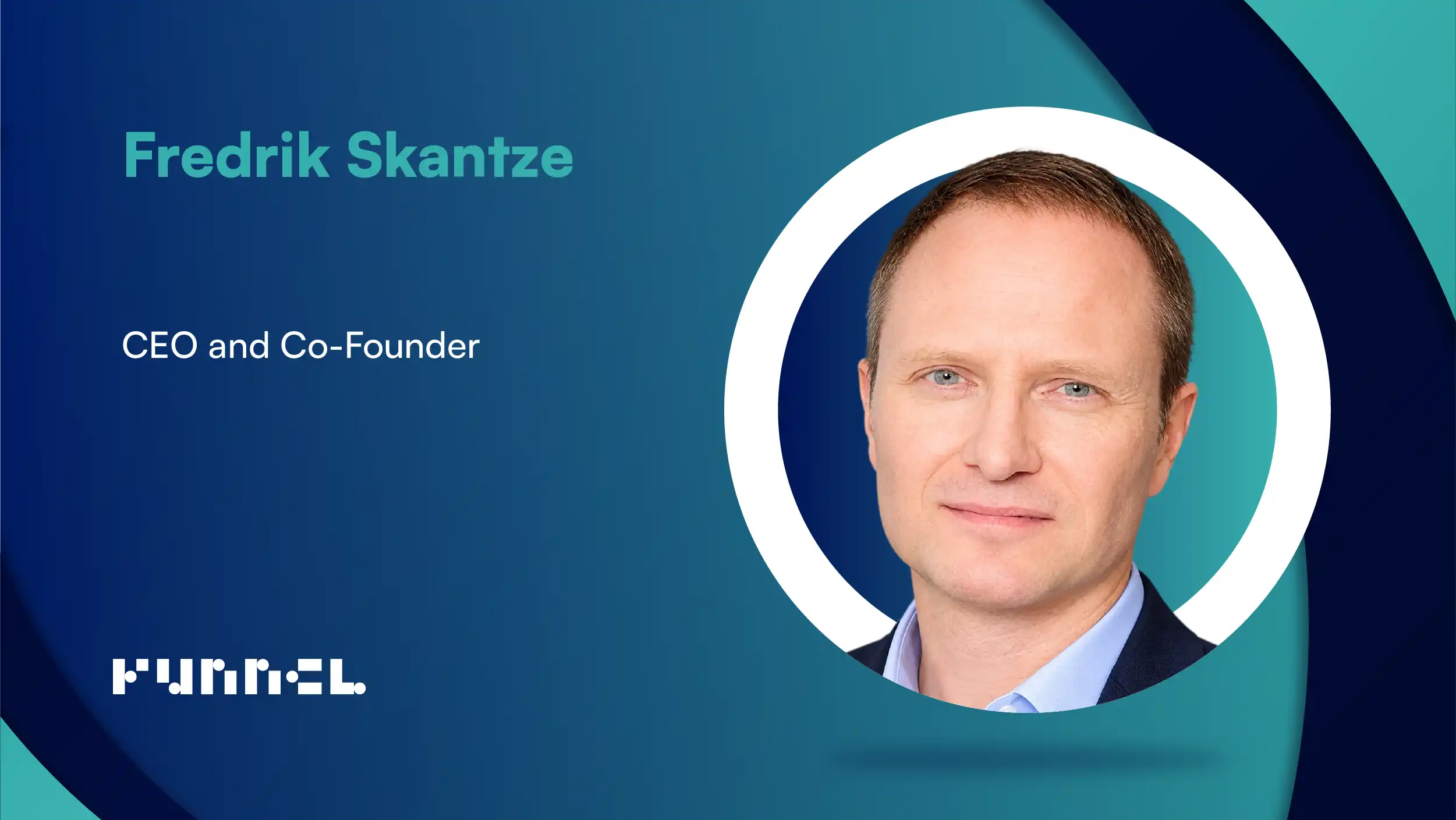
MarTech360 Interview with Fredrik Skantze, CEO and Co-Founder at Funnel

“Your absolute top priority must be data, data, data; if and when AI projects in marketing disappoint, the cause is nearly always data quality.”
Fredrik, your career has moved from developing software at ABB Robotics to building businesses across enterprise technology, online retail and advertising technology. What early lesson still shapes how you identify problems worth solving and turn them into products?
Having trained as an engineer at MIT, I spent much of my time academically focused, but my training was not enough to build a company around. I therefore went into industry and worked in software development and R&D at ABB Robotics. The lesson I carried with me from that period was that an invention needs a customer problem behind it before it can become a business: my inventions worked, but none of them answered a problem customers were ready to pay to solve.
When we started Funnel, everybody had a spreadsheet and the marketers we spoke to told us that if we built an automated alternative, they would buy it. That is still how I judge whether a problem is worth turning into a product.
You moved from Qwaya to Funnel after recognizing that marketers needed more than tools to create advertising. They needed a better way to understand performance across channels. What did that transition teach you about recognizing where the real opportunity lies in a market?
Before Funnel, we built Qwaya, a Facebook advertising tool for SMEs that processed around $100 million in ad spend on Facebook, roughly 1% of Facebook’s revenue at the time. However, we struggled to see a path to scaling it the way we would’ve liked, partly because the business was so closely tied to one platform.
At the same time, we were operating in a space that no one else was filling, whereby marketers had plenty of tools to make and optimise ads, but when it came to understanding the P&L of their marketing, the actual performance across all channels, everybody had a spreadsheet. The transition taught me to look for work that every customer is doing by hand and that nobody has automated, which is where the more substantial opportunity usually lies.
If you have to take a little more time to create the tool that’ll solve customers’ issues more effectively, do it. Building Funnel took two years rather than the one we planned precisely because every customer’s spreadsheet was slightly different, confirming to us that the problem was real.
Also Read: MarTech360 Interview with Gabriele Franco, Co-founder at Cassandra
You have spent more than a decade building Funnel through major shifts in digital marketing, from social advertising and privacy changes to AI-driven analytics. What has changed most in the way marketers measure performance, and which fundamental measurement problem remains unresolved?
Measurement has fundamentally changed even in the last few years, shifting from a data integration problem to one of data science. Back in 2010, digital-only brands could rely on click-based attribution because many of their channels produced clicks and cookies made customer journeys traceable.
Two things undermined that: privacy regulation and browser restrictions. These removed much of the signal, and, more significantly, large TV budgets moved online into video advertising on YouTube, TikTok, Facebook and Instagram, which builds brands but produces few clicks.
Marketing has now gone digital, so an even higher share of activity is going unexplained at the same time that click-based models shrink (though these have not disappeared entirely). The most common problem, and our oldest one, that remains unresolved is to connect marketing to sales when prices, competitor activity and seasonality are all moving at once. Whether a person or an AI runs the campaigns, someone still needs to know the impact of what they do relative to the cost. That’s why we’ve opened Funnel up through MCP (model context protocol), so that the AI tools marketers already use can query the same data their teams rely on.
Winterberry Group's 2026 research found that 83% of surveyed enterprise marketers see cross-channel budget optimisation as a leading priority, yet only 9% say they practice unified measurement extremely well. Why has the gap persisted, and what would it take for measurement to genuinely guide marketing investment?
Winterberry’s figures match exactly what we see in our own research with Ravn Research, with 86% of in-house marketers said they could not determine the impact of each marketing channel on overall performance, a gap which persists for two reasons.
One is outdatedness: data is rarely ready, so many measurement projects begin with six months of gathering and cleaning, with offline data often still arriving as spreadsheets by email. When the models do produce answers they can contradict long-held convictions about which channels work which organisations find hard to accept. Measurement has to run continuously for it to guide investment.
Marketers can increasingly see which channels receive credit for conversions, but that does not always reveal which channels actually created incremental growth. As attribution, marketing mix modelling and incrementality testing evolve, how should marketing leaders bring these different signals together to make more reliable decisions?
Attribution shows which channel was closest to a sale rather than what caused it. For well-known companies, if they stop marketing, they could probably retain a majority of their sales anyway because they have a really strong brand (the ‘baseline’). Last-click models hand that baseline to whichever paid channel happened to be present; MMM is the right core because it accounts for the baseline and for the delayed effect of spend. It works from relatively little data, however, so it needs grounding.
Incrementality tests supply experimental evidence, and attribution and platform data add granular detail. Measurement is really hard. There are so many variables, and you can’t control for all of them, but by using all the available data and applying different methods, including using a machine learning framework to triangulate between them, marketers can get the best estimate.
AI is changing marketing analytics from a discipline that primarily explains past performance into one that can increasingly recommend and automate decisions. What needs to change in the underlying data, measurement models and workflows before marketers can trust AI to guide their next move?
Your absolute top priority must be data, data, data; if and when AI projects in marketing disappoint, the cause is nearly always data quality. All too often, data sits in silos across advertising platforms and analytics tools. The first thing that should change is for data to be brought into one foundation with a semantic layer that maps it to the advertising data model and to the company’s own business logic.
Measurement then sits on top, producing one detailed, correctly mapped dataset. That dataset is what AI should query and it is what agentic workflows and reporting should run on, so that people and agents work from the same numbers.
The second change is in the models. We don’t believe measurement should be a black box and that every decision should be transparent, even if made by an agent. Marketers will trust AI recommendations when they can see how each one was reached.
Zero-click search and AI-generated answers are changing how consumers discover brands, often without visiting a website or triggering a conventional conversion signal. How should marketers rethink visibility, influence and campaign effectiveness when an increasing share of the buyer journey happens beyond traditional tracking?
AI search is a new channel that has not yet found its advertising model. There are still high numbers of searches happening on Google because AI gives you a quick answer right there on the page. But fewer people are clicking through. Google built its business on sponsored links, and Facebook only found its model when ads moved into the news feed. AI assistants will go through a similar cycle, and marketers will gain new channels to buy. Until then, much of their influence will leave no click to track.
Our latest research found that 39% of marketers blame zero-click search for weaker organic performance, while 68% have not even tried to quantify its impact. Marketers should start by measuring it. Marketing mix modelling and incrementality testing can estimate the contribution of activity that produces no click, and both apply to search and content budgets today.
Marketing leaders face growing pressure to demonstrate how campaigns contribute to business outcomes, while short-term attribution often struggles to capture long-term brand value. How can organizations build a more credible picture of marketing effectiveness that resonates with both marketing teams and finance leaders?
Credibility with finance starts with one set of numbers. In many companies, the CMO’s reporting to the CFO and the campaign team’s day-to-day optimisation run as separate processes on different figures. The fix is one measurement dataset that serves both the CMO’s conversation with the CFO and the work of the operational teams with everybody working from one source of truth. Long-term brand value then needs modelling while still tracking clicks.
Marketing mix modelling separates the baseline, the sales a brand would earn without marketing (from the effect of spend), and it captures the lag before advertising pays back. When we analyse clients’ data this way, we often find that bottom-funnel channels are saturated and that moving some budget into brand or mid-funnel activity brings new customers into the funnel, giving finance evidence it can examine.
Funnel has expanded from marketing data collection and reporting into a broader platform spanning data infrastructure, measurement and optimisation. As AI raises expectations around connected intelligence and faster decisions, how do you decide which capabilities marketers need next without making the platform more complex?
We build one standard product for every customer, advertisers and agencies alike, and we don’t customise it - the one exception being data in and data out. We will build any data source or destination a customer needs under a service-level agreement because every fourth new customer or so arrives with a platform we have never seen. Our new capabilities tail the problems customers bring us. Our current focus is conversational analytics and agentic measurement and we’ve launched Funnel AI for our customers to ask our platform specific questions without the need for a middleman, either in our app or using our MCP to connect Funnel with their AI platform of choice. We are seeing an exponential adoption of Funnel AI and our MCP to an extent I’ve rarely seen, which clearly shows where the market is heading.
Looking ahead, AI-mediated discovery, changing attribution models and increasingly autonomous analytics could fundamentally reshape marketing intelligence. What is one assumption about measuring marketing effectiveness that you believe organizations will need to rethink over the next five years?
Organisations will need to rethink the assumption that measurement exists mainly to report results to leadership. AI already handles bidding on the major platforms and increasingly produces the creative, and agents will take on more of the planning and buying. Those systems need to know what is working in order to act and measurement then guides the next decision.
Models need refreshing every day rather than being delivered every six months, and the data beneath them has to be accurate enough to automate on. Marketers will still set the strategy and question the outputs, but if AI is doing more of the marketing, knowing what’s working is one of the few competitive edges that remains entirely yours.
Thanks, Fredrik!
Fredrik Skantze is a technology entrepreneur and business executive with experience spanning marketing intelligence, data analytics, product development, and enterprise software. As CEO and Co-founder of Funnel, he has focused on building solutions that help organizations collect, unify, analyze, and report marketing data from multiple platforms. His professional background includes founding and leading technology businesses, along with product and marketing leadership roles at companies such as Qwaya, Autoquake, and Openwave. With an engineering background from MIT and an MBA from Stanford Graduate School of Business, Skantze brings together technical and business perspectives on marketing technology. His work centers on addressing challenges around fragmented marketing data, performance measurement, attribution, and the growing role of AI in marketing decision-making.
