
MarTech360 Interview with Žilvinas Lešinskas, VP of Product at Omnisend
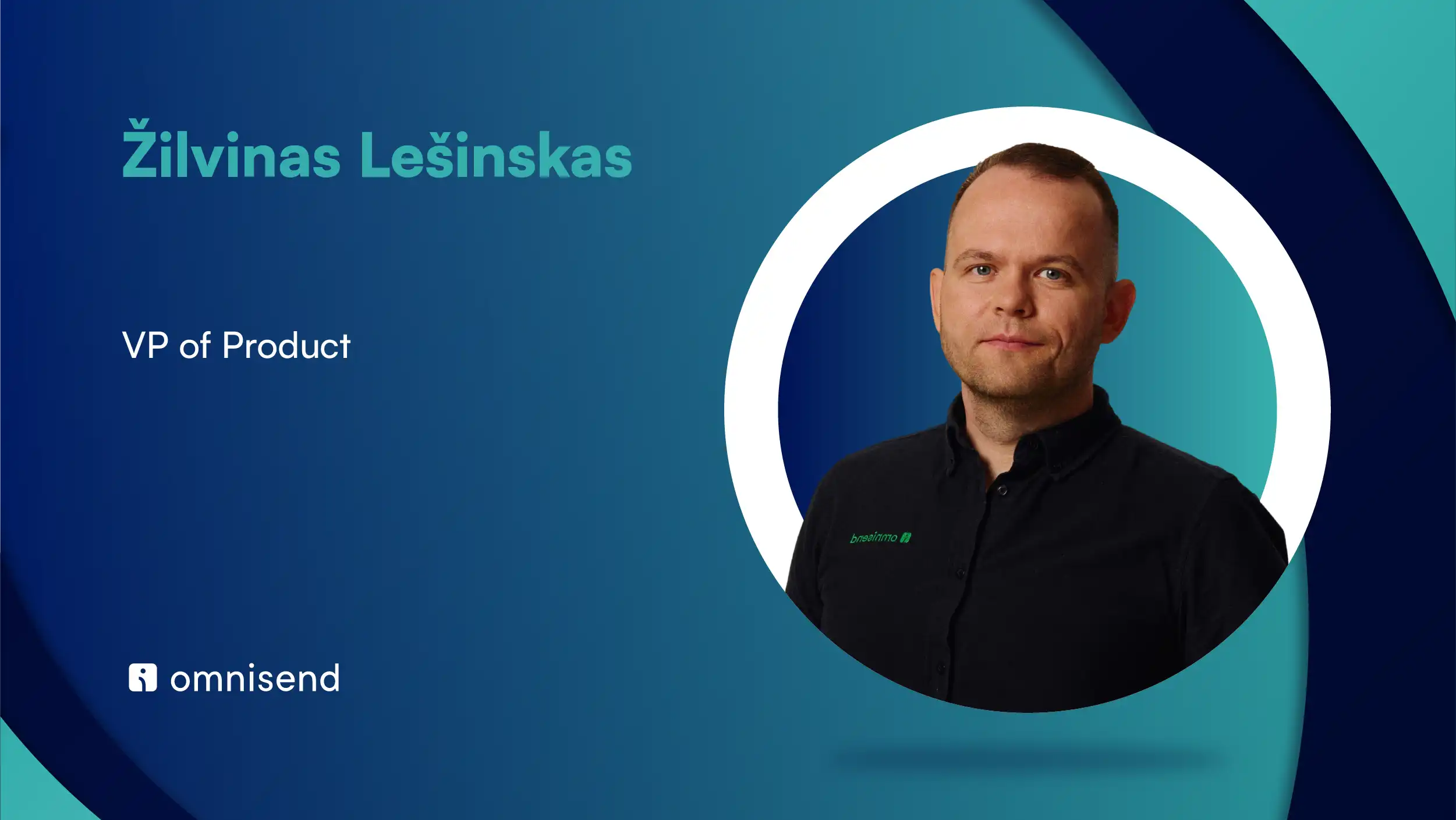

“If they've built their own workarounds, like a notebook, a spreadsheet or a phone call, the need is real. “A clever answer to a question nobody is asking is still wasted effort.”
Žilvinas, your career has moved from advertising and creative direction into product leadership at CGTrader, Treatwell, and Omnisend. What early lesson still shapes how you identify the problems worth solving for customers?
The lesson I carried over from advertising is that every role in business combines mathematics and creativity in some way. By mathematics, I mean signals. In advertising, they come from brand perception, market share, and the audience. In product, they come from user behavior, data, and customer conversations. Creativity is what you do with those signals: you turn them into a message, a product, or a decision that didn't exist before. The higher I've moved, the truer this has become, and that includes management.
In product, we call it separating the problem space from the solution space. The most common mistake I see is jumping straight to solutions without taking the problem apart first. A clever answer to a question nobody is asking is still wasted effort. As for which problems are worth solving, I measure every signal and every problem we uncover against the business goals. If solving it doesn't move them, it waits.
At Treatwell, you worked across the entire product lifecycle, from user research and problem discovery to rollout and measurement. What did that experience teach you about distinguishing a genuine customer need from a feature request?
Get to know your users and work alongside them, especially when the domain isn't intuitive to you. At Treatwell, I was building software for barbers, hairdressers, and beauticians. I've never been any of those. They didn't know how software gets made, and I didn't know how to apply hair extensions. So I would fly to London and other cities and spend full days shadowing the people I was building for.
Feature requests usually reach a product team as one-liners from support or sales. Customers ask for a feature because they believe it will solve their problem, but the root cause often sits somewhere else. Shadowing is how you find it. You see the real workflows, both when people use the software and when they're working without it. That second part is the giveaway. If they've built their own workarounds, like a notebook, a spreadsheet or a phone call, the need is real.
At Omnisend, you have focused on customer activation within a product-led growth model. What separates a user who has simply completed onboarding from one who has genuinely experienced the product’s value, and how do you help more customers reach that point?
Getting new users to value is the goal. Onboarding is just the means. For us, value means Omnisend helps the business in a measurable way, such as automations bringing in sales that wouldn't otherwise happen. Completing setup isn't the same thing.
An onboarding flow is your best bet on how a particular segment reaches that value. But customers are individuals, not a monochrome segment. So you personalize, make the UX intuitive, and build more than the happy path: a support system around it, with academies and setup videos. Customers aren't machines, and they will get lost. Your job is to motivate them enough to find their way, and to give them a hand when they need it.
You emphasize rapid experimentation and learning from customer behavior. How do you decide when a team should move quickly with an experiment and when a problem deserves deeper research before committing to a solution?
Move fast whenever you can. The exceptions are irreversible decisions, or business or technology risks that would hurt you significantly down the road. Those deserve deeper research before you commit. Everything else should be tested, because a quick experiment teaches you more than weeks of discussion.
But speed has a purpose. You move fast to prove that the solution you envision creates value for customers or for the business. That only works if you know what you're trying to prove. If you can't say what you're measuring and why, you're not experimenting, you're just shipping.
Omnisend’s 2026 Ecommerce Marketing Report found that automated emails accounted for 2% of sends but generated 30% of email-driven revenue in its 2025 analysis. What does this reveal about timing and relevance, and how can product teams make effective automation accessible to smaller businesses?
Those numbers show something bigger than email. Marketing as a whole runs on timing and relevance. Email just happens to be the channel where you can personalize journeys most deeply. Automations prove the golden rule, because they run on specific scenarios triggered by what a shopper actually did. Timing, personalization and channel choice are everything. A campaign is the brand deciding when to talk. An automation lets the customer's behavior decide.
Also Read: MarTech360 Interview with Christina Kyriazi, Chief Marketing Officer at PhotoShelter
For small businesses, the barrier is know-how, and our job is to remove it. We start with ready-to-use automations a merchant can turn on in minutes and refine later, and we show results clearly so the value is obvious early. Now we're going further. Omnisend's built-in AI agent builds journeys for merchants. It understands the details of their business and writes in their language, so they get expert-level automation without needing to be experts.
Omnisend brings email, SMS, web push, and automated customer journeys into one platform. How do you decide which channel best serves a customer in a given moment, while ensuring that a more connected marketing experience does not become more complicated for businesses or their customers?
I'd shift the question a little. It's not about the channel, it's about the shopper and what they need in that moment. Email suits richer content people come back to. SMS is for high-intent moments, and it works best when used with restraint. Web push reaches people who are interested in a store but haven't connected with it yet.
Keeping a connected experience from becoming complicated is the software's job, not the merchant's. It starts with one customer profile: every channel draws on the same picture of the shopper, so the experience feels consistent on their side. Then one journey builder brings all channels into a single workflow instead of separate tools. On top of that, pre-built journeys mix channels sensibly by default, so merchants start from something that already works.
Omnisend is extending AI beyond content creation into campaign recommendations, performance insights, and workflow management. As software becomes more capable of acting on a marketer’s behalf, what determines when AI should recommend an action, execute it, or leave the decision to a human?
The marketer decides, not the software. Different marketers and brands will be comfortable handing AI different levels of responsibility, from advice to execution to strategy and building. It's their call where on that spectrum they sit. Our job is to make every level available and safe.
In practice, most people start by letting AI handle what's low-risk and easy to undo. When something touches their brand, budget, or customer relationships, they want a recommendation and an explanation first. That boundary moves over time, because trust builds as people see results. The goal is to take away repetitive work, so marketers spend their time on what matters most.
Personalization depends on understanding customer behavior, yet more data does not automatically create better experiences. How can product teams help ecommerce businesses turn customer insights into more relevant communication without compromising trust or overwhelming marketers with complexity?
More data doesn't automatically mean better decisions. It's just more signals. The value lies in synthesizing them into something useful, and for a merchant, that means knowing what to do next. Making sense of the data is the software's job, not the merchant's. Our AI agent increasingly does that work: it turns insights into journeys and messages, so the merchant sees a clear recommendation instead of a wall of segments and properties.
On the shopper's side, the test is simple. Good personalization feels like good service: a timely reminder, or a recommendation based on what someone actually bought. It shouldn't feel like being watched. That means respecting consent and using data the way customers would expect. Shoppers are individuals, and they notice when they're treated like one, and when they're being tracked like one.
Your current responsibilities span product leadership and interim engineering leadership. How has working across both areas shaped the way you balance customer-facing innovation with reliability, technical foundations, and the long-term health of the product?
I don't see my job as balancing innovation and reliability myself. It would be naive to claim I can hold all of that in my head. My job is to build a strong leadership team of seasoned professionals who can strike that balance, because they understand our strategy, the company's long-term goals, and where we stand today.
What I bring is knowing which questions to ask and when, and bringing the right people into the conversation. Product people sometimes see reliability as something that slows them down, while engineers see it as what makes speed possible. Both are right, and good decisions come from having both views at the same table. So for me it's about building strong organizational leadership, not balancing things on my own.
As AI begins to influence how consumers discover products and how businesses manage customer relationships, what do you believe ecommerce marketing platforms will need to get right over the next few years, and which principle from your own product philosophy must remain unchanged?
I'll be honest: no one knows exactly how this will evolve. But as I see the world now, and for at least the year ahead, marketing will stay as emotional as it is rational. Shoppers will still want to see what they're buying, understand the story behind a brand and know what it stands for, and marketers will still want to tell that story. So marketing will stay human, and the narrative a brand builds will rely heavily on human judgment.
Platforms have to respect that. Their job is to help merchants automate, save time and co-create, while creativity and the brand narrative stay with marketers. Good taste will outlast any rule in marketing automation.
The principle I'd keep unchanged is the one I started with: business is mathematics and creativity. AI is getting very good at the mathematics. For now, the creativity is still ours.
Thanks, Žilvinas!
Žilvinas Lešinskas is a product and technology leader with experience spanning product management, creative direction, customer research, and business growth. He currently serves as Vice President of Product and interim Vice President of Engineering at Omnisend, where he oversees product strategy and development, focusing on customer needs, product-led growth, and AI-driven innovation. Before joining Omnisend, he held product leadership roles at Treatwell and CGTrader, gaining experience across the product lifecycle, from identifying customer problems and conducting user research to developing, launching, and optimizing digital products. His approach combines data-driven decision-making with creativity and direct customer engagement. At Omnisend, he focuses on making product development more customer-centric by using technology and AI to analyze feedback, prioritize problems, and improve user experiences. He studied at Loughborough University, where he graduated with First Class Honours.
