
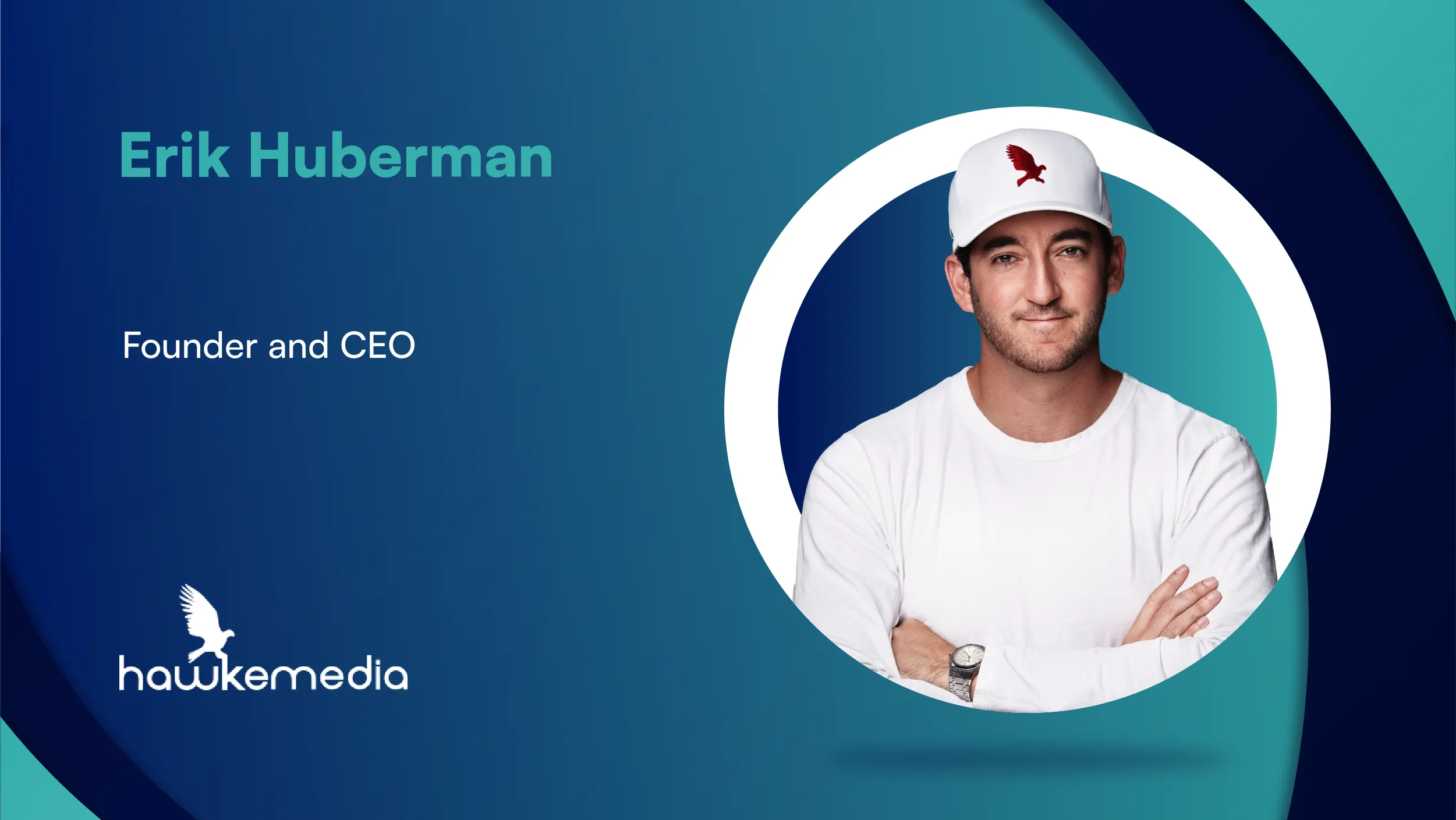
MarTech360 Interview with Erik Huberman, Founder and CEO at Hawke Media

"AI can make content creation faster, but it can’t replace having a point of view. Brands that use AI to amplify genuine expertise, creativity and customer insight will have an advantage. Brands that use it to create more noise are just going to contribute to the problem."
Erik, could you tell us about your entrepreneurial journey and what led you to build Hawke Media? How has your perspective on marketing changed since you first entered the industry?
I’ve been an entrepreneur for most of my career. Before Hawke Media, I built and sold a couple of ecommerce companies, and through that experience I saw firsthand how difficult it was for growing businesses to get access to good marketing.
The options were pretty broken. You could hire an expensive agency, build an entire in-house team before you were ready for one, or work with a bunch of freelancers and try to manage everything yourself. I saw an opportunity to create something more flexible, which became Hawke Media.
We founded Hawke Media in 2014 on the idea that every modern business deserves access to expert-level marketing. The model was essentially to give companies the resources of a full-service agency with the attention and flexibility of an in-house team, which is where the idea of the Outsourced CMO came from.
My perspective on marketing has definitely evolved, but the fundamentals haven’t changed as much as people think. The channels change. The technology changes.
Consumer behavior changes. But ultimately, good marketing is still about understanding your customer, giving them a compelling reason to care and building a business around delivering that value consistently.
Also Read: MarTech360 Interview with Marc Hutchinson, Vice President, Solution Architecture at TTEC Digital
Hawke Media has worked with brands across performance marketing, creative, content and growth. What are the biggest changes you have seen in the way brands approach customer acquisition compared with when you founded the company?
When I started Hawke Media, customer acquisition was a lot simpler. You could put money into Facebook or Google, target the right audience, have decent creative and see pretty predictable returns.
That world doesn’t really exist anymore. There’s more competition, acquisition costs have gone up, targeting has changed and consumers are being hit with more content and advertising than ever before.
The biggest shift is that brands can’t rely on one channel to drive growth anymore. Your paid media, creative, website, email, organic content, PR, influencers and retention strategy all have to work together. If you’re expecting your ads to do all the work, you’re going to have a hard time scaling efficiently.
Customer acquisition today is really about building an ecosystem. The brands doing it well understand how all of those touchpoints work together instead of optimizing each one in isolation.
AI is fundamentally changing how consumers discover information, products and brands. With search increasingly moving from traditional results toward AI-generated answers, how should marketers rethink what “visibility” means?
For a long time, visibility meant ranking on Google. If someone searched for something related to your business, you wanted to be one of the first links they saw.
Now someone can ask ChatGPT, Perplexity or another AI platform a question and get an answer without ever clicking through a traditional list of search results.
That changes the goal. It’s no longer just, “How do I rank for this keyword?” It’s also, “How do I make sure my brand is part of the answer?”
Marketers need to start thinking about visibility across the entire discovery ecosystem. Search engines still matter, but so do AI platforms, social platforms, creators, publishers, Reddit and all of the other places consumers are gathering information and forming opinions. The customer journey is becoming much more fragmented, and your brand needs to be discoverable wherever those decisions are actually happening.
Hawke Media has been exploring AI-powered search optimization and the changing consumer discovery journey. What does it take for a brand to become part of the answer when consumers increasingly turn to AI rather than traditional search engines?
This is where GEO, or Generative Engine Optimization, becomes really important.
With traditional SEO, you’re largely optimizing content around keywords and search intent so you can rank in search results. With GEO, you’re thinking about how your brand and content get understood, referenced and surfaced by large language models.
And that goes beyond publishing a bunch of articles on your own website. AI systems are pulling information from across the web, so brands need a broader digital footprint.
That means having strong content on your own site, but it also means PR, third-party publications, credible mentions, reviews, affiliate content and conversations happening on platforms where people are actually discussing your category.
The goal is to build enough authority and context around your brand that when someone asks an AI platform a relevant question, there are clear signals connecting your company to the answer.
As generative AI makes it easier for virtually any brand to produce content at scale, do you think content volume will become less important? What will determine whether content actually earns attention and influences a buying decision?
The barrier to creating content is basically disappearing. Anyone can generate 100 blog posts, social captions or ads now. That means simply producing more content isn’t much of an advantage.
If anything, the flood of AI-generated content makes originality and trust more valuable.
The question becomes: Do you actually have something worth saying? Do you understand your customer? Are you providing information, entertainment or insight that they can’t get from every other brand using the same tools?
AI can make content creation faster, but it can’t replace having a point of view. Brands that use AI to amplify genuine expertise, creativity and customer insight will have an advantage. Brands that use it to create more noise are just going to contribute to the problem.
Hawke Media has also invested in AI-driven marketing capabilities, including HawkeAI, which was designed to bring data, insights and automated marketing strategy together. Where do you see the greatest opportunity for AI to move marketers from simply analyzing performance to actually improving marketing decisions?
The biggest opportunity is closing the gap between data and action.
Most companies don’t have a shortage of data. They have Google Analytics, Meta, Shopify, their CRM, email platforms and a dozen other tools giving them information. The problem is figuring out what matters and what to do about it.
That’s a big part of what we’ve focused on with HawkeAI. Instead of just showing you another dashboard, the goal is to help identify what is happening, why it matters and what action you should take next.
AI can process a massive amount of information much faster than a person can. That gives marketers an opportunity to spend less time pulling reports and more time making decisions. I think that’s ultimately where this goes: AI becomes less of a reporting tool and more of an intelligence layer that helps marketers continuously identify opportunities and make better decisions.
Performance marketing has traditionally been heavily focused on measurable, short-term outcomes, while brand building often requires a longer-term perspective. How can marketers balance immediate performance with building a brand that consumers remember and trust?
I’ve never really believed that brand and performance should be treated as two completely separate things.
Performance marketing captures demand. Brand creates demand. You need both.
The challenge is that performance is easier to measure immediately, so companies naturally gravitate toward it. You spend a dollar, see what comes back and make a decision. Brand doesn’t always work on that timeline, but that doesn’t mean it isn’t contributing.
The best marketers understand that you still need accountability and measurement, but not every marketing decision can be judged by what happened in the next seven days. If all you do is capture existing demand without investing in awareness, trust and affinity, eventually you run out of demand to capture.
Hawke Media has argued that brands increasingly need to think and operate like media companies, particularly as content, social and creator-led marketing become more important. What does it actually mean for a brand to operate like a media company today?
I encourage almost every brand we work with to start thinking like a media company.
What I mean by that is creating a reason for your audience to engage with you beyond buying something. If you sell running insoles, for example, don’t only post about why people should buy your insoles. Create content about running. Talk about great trails. Build a running community. Host meetups. Interview athletes. Become a destination for people who care about the world your product exists in.
That does a few things. It keeps your existing customers engaged, gives potential customers a reason to discover you and creates content people actually want to share.
People are much more likely to send a friend a great piece of content than a product page. That creates word of mouth, builds community and keeps your brand relevant even when someone isn’t actively shopping.
The brands that understand that are going to have a major advantage because they’re not constantly renting attention. They’re building an audience of their own.
As AI, automation and increasingly sophisticated marketing platforms become widely accessible, many brands may end up using similar tools and strategies. In your view, where will meaningful differentiation come from in the next phase of digital marketing?
The tools are going to become commoditized. If everyone has access to the same AI models, advertising platforms and automation tools, having the technology itself isn’t going to be the advantage.
The advantage is going to be what you do with it.
That comes back to understanding your customer better than your competitors do, having a strong brand, creating genuinely interesting ideas and executing faster.
I actually think creativity becomes more valuable in an AI-driven world, not less. When everyone can produce something that is technically good, being technically good becomes the baseline. The brands that stand out will be the ones with a distinct perspective, a strong understanding of their audience and the willingness to do things that don’t look exactly like everyone else.
Looking ahead, what do you believe will fundamentally change about marketing over the next three to five years, and what should CMOs and brand leaders start doing today to prepare for the shift?
Marketing is going to become much more fragmented and much more automated at the same time.
AI will handle an increasing amount of the execution, optimization and analysis that marketers spend time on today. At the same time, consumers are going to discover brands across more places: AI platforms, social, creators, communities, traditional search and probably channels that haven’t become meaningful yet.
That means marketers need to get really good at two things: building a brand people actually care about and building the infrastructure to understand what is working across all of those different touchpoints.
I wouldn’t spend the next few years trying to predict which individual platform is going to win. I’d focus on the fundamentals that carry across platforms: know your customer, own your data, build an audience, create content worth consuming, establish authority around your category and get comfortable experimenting with AI now.
The companies that wait until these shifts are fully established are going to be playing catch-up. The opportunity right now is to experiment while everyone is still figuring it out.
Thanks Erik!
Erik Huberman is an entrepreneur, marketing executive, and agency leader best known as the Founder and CEO of Hawke Media. His professional background spans digital marketing, e-commerce, business growth, and entrepreneurship, including founding and building multiple businesses before establishing Hawke Media in 2014. His work has centered on helping brands approach marketing through a combination of strategy, performance, customer acquisition, and retention.
