
MarTech360 Interview with Joep Leussink, Chief Growth Officer at AddEvent
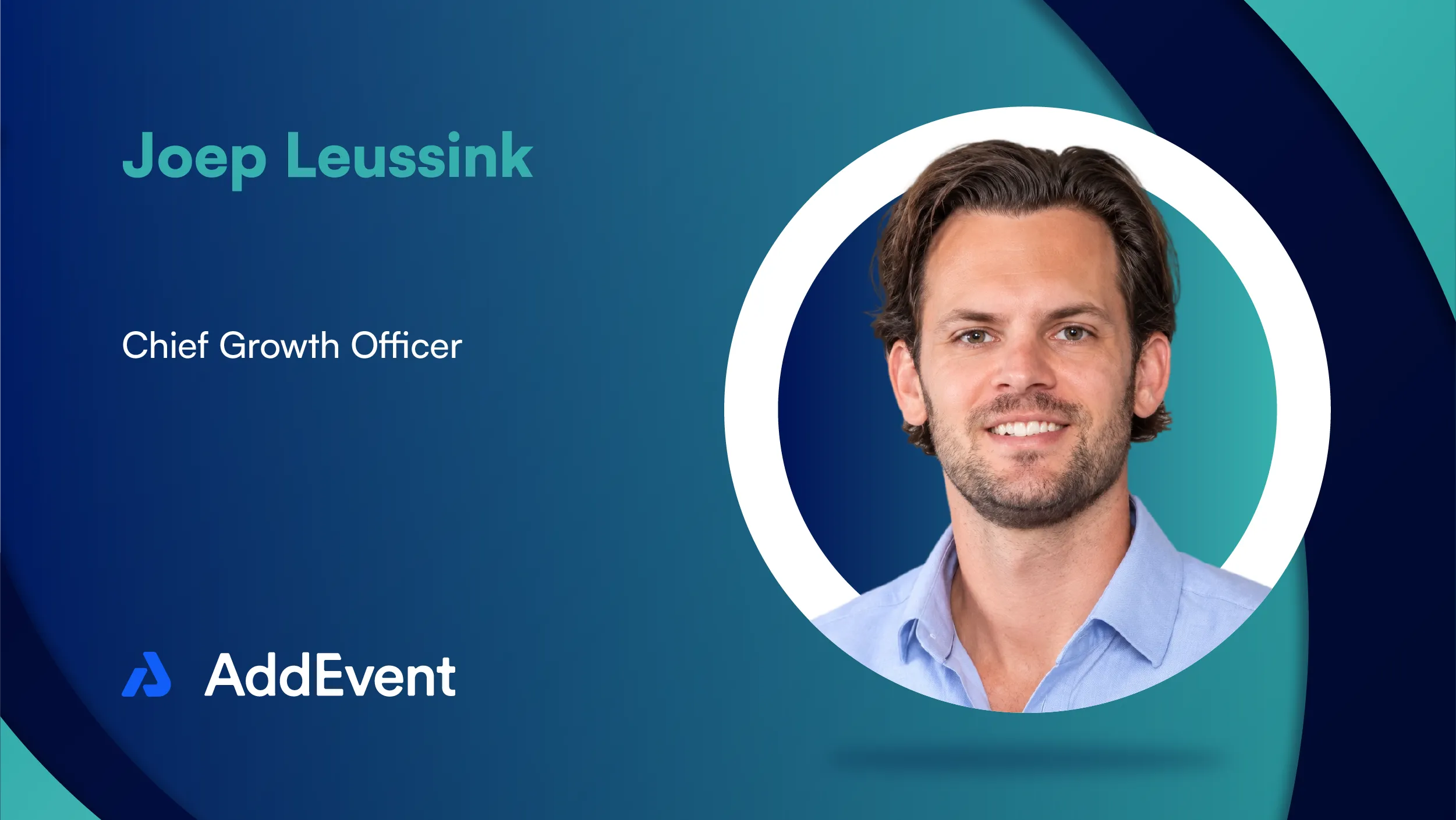

“Marketers have long focused on attention metrics like opens, clicks, and impressions, but as stated previously, engagement doesn’t guarantee follow-through. The bigger opportunity is improving what happens after someone shows intent.”
Joep, your career began with website development and online marketing before moving through e-commerce, analytics, and SaaS growth leadership. What early lesson still shapes how you understand the relationship between customer experience and commercial growth?
Winning a customer is just the start. Sustainable growth comes from helping them succeed. The customer's outcome matters more than the product interaction itself, which is why, at AddEvent, the goal isn’t simply to get someone to click an “Add to Calendar” button. Instead, the goal is to help ensure that person actually attends the event or shows up to their appointment. That is where a better customer experience connects directly to a commercial result.
I’ve also learned that it’s important not to try to do too many things at once. By focusing on delivering value first, you can earn a customer’s trust and create opportunities to expand the relationship over time. A successful business model should support that same principle, for instance, AddEvent charges mostly based on usage. As customers get more value from AddEvent and their usage grows, they pay us incrementally, creating a win-win for both parties.
You joined AddEvent as Head of Growth before becoming Chief Growth Officer, during a period of product expansion. What did you see in calendar marketing when you first joined, and how has your understanding of its growth potential evolved since then?
At first, I saw calendar marketing as a strong channel for engaging people who had already shown intent, because getting an event, appointment or timely reminder directly onto someone’s calendar significantly increases the likelihood that they show up. While I initially thought about this channel in the context of important events such as appointments or webinars, I started to realize that the opportunity was much bigger.
Most people rely on their digital or mobile calendars to check their schedules or plan their days, giving this channel the unique opportunity to reach customers on a platform they are already using daily. As opposed to other marketing channels that are primarily focused on capturing demand, calendars are more likely to turn intent into action because they help people plan when and where they need to be. The opportunity also goes beyond individual events, as calendar subscriptions allow companies to build their own ongoing marketing channel, something we’re seeing across many industries.
What changed for me was realizing that the opportunity wasn’t limited to individual events. Today, I see it across three types of moments: events people want to attend, schedules they want to follow, and appointments they need to keep. AddEvent helps businesses connect those moments to their customers’ calendars.
Also Read: MarTech360 Interview with Rafa Flores, Chief Product & Growth Officer at Treasure AI
Businesses invest heavily in email, paid media, and social media, while calendars ultimately help people decide how they spend their time. What makes calendar marketing a distinct customer engagement channel, and what do you think businesses still underestimate about its potential?
Calendar marketing is an opt-in channel, and that intent makes it particularly powerful. A recent Time Management Statistics report from UseCarly found that 23% of people manage their to-do lists through their calendars, highlighting how central they are to daily life. When someone subscribes to a calendar, they’re choosing to make room for that content in their schedule. We see the value of that choice reflected in data from our own customers, which showed that 83% of individuals who ever subscribed to a calendar continue to remain subscribed today.
Compare that with crowded email inboxes and social feeds where businesses are competing for attention. Calendar marketing gives companies an opportunity to build an ongoing connection with people who have actively chosen to engage, without relying on cost-per-click pricing, privacy changes, or social algorithms. I think businesses still underestimate the value of having a direct, opt-in channel that helps them stay connected to their audiences over time.
ON24’s 2026 benchmarks found that average webinar attendance grew 11% in 2025, while 60% of registrants attended. What does this gap reveal about the journey from initial interest to actual participation, and where can calendar engagement make a measurable difference?
People are busy, and registering for an event doesn’t mean they’ll remember to attend. SMS and email reminders have a higher potential for getting lost or disregarded, while calendar reminders have access to these individuals on a high-visibility platform they reference throughout the day.
Across various customer use cases, we’ve seen attendance rates increase by more than 30% when the registrant adds the event to their calendar. People use their calendars as a source of truth for where they need to be and when, so adding an event to their calendar makes it easier to remember and mitigates the potential for double-booking. It’s a simple step that can make a measurable difference in turning registrations into attendance.
In your April 2026 case study on O’Reilly, you explored the challenges of distributing thousands of live sessions as its event operations scaled. What did that experience reveal about the small points of friction that can become significant barriers to engagement as a business grows?
Every extra click creates another opportunity to lose a customer. At O’Reilly, users had to click, download an ICS file, find it on their computer, and manually add the event to their calendar. Many never completed the process or didn’t understand what they needed to do, and attendance suffered because of those unnecessary hurdles.
The lesson there is that intent to attend doesn’t always translate into commitment. If saving an event is difficult or confusing, people may drop off before you even have the opportunity to remind them the event is coming up. These issues become more significant as programs scale, especially when the experience differs across channels. Fixing the registration process on a website, for example, doesn’t necessarily help someone registering via email, so it's important for businesses to reduce any points of friction across the entire customer journey if they want to maintain steady engagement.
Your background spans product-led growth, conversion optimisation, and customer lifecycle marketing. In a self-serve SaaS product like AddEvent, what signals tell you that users have found genuine value, and what separates an initial successful experience from a habit that drives long-term retention?
I think about the customer journey in three stages: “This works,” “I need this again,” and “Where else can we use this?” First, users need to see that the product works and delivers value. Then, they need to recognize a recurring need and make it part of their workflow. From there, they can expand by adopting other features or introducing the product to more departments. Turning that initial success into a repeatable process or habit is what drives long-term retention and creates opportunities for expansion.
One of the strongest signals of value in a self-service product is when users return without being prompted because the product has become part of their workflow. Adopting new functionalities and expanding their usage are also key signals of long-term retention.
Expansion is an especially strong signal. For example, one person might start using the software or product independently or for their own team. If they’re happy with their experience, they may then introduce it to other departments or integrate it into additional workflows. As more team members adopt the product, that growing usage is a strong indication that customers are seeing value and finding new ways to use the product across the broader organization.
AddEvent can track calendar clicks, RSVPs, and subscriptions, while the eventual business outcomes may sit across several systems. How should growth teams connect these engagement signals to attendance, pipeline, and revenue to build a more complete picture of marketing performance?
Calendar clicks, RSVPs, and subscriptions are great signals, but they shouldn’t exist in isolation. The outcomes that matter, such as attendance, qualified opportunities, pipeline, and sales, usually live across different systems, so growth teams should bring that data together. Teams can do this by connecting AddEvent into their CRM or analytics tools like HubSpot, Salesforce, and Google Analytics, to provide better visibility into how an individual’s calendar activity connects to those outcomes.
Once the data is connected, we recommend looking at a cohort of events or customers to see how implementing AddEvent impacted their business. Comparing events or customers with and without calendar CTAs, or before and after AddEvent’s adoption, can also provide a clearer picture than looking at data from AddEvent’s platform alone.
UTM tracking is a practical part of the picture. We always tell our customers that for any event, like a holiday sale or a product release, they should include a link to their website with utm_source=calendar. This allows them to attribute revenue to their calendar marketing efforts and gives teams a clearer picture of the strategy’s overall impact.
When measuring calendar subscription performance, I’d say audience growth is the most important metric to look at. Subscription calendars act as a company’s own ongoing, opt-in marketing channel, so the greater the subscriber count, the bigger the audience a company can now actively engage with for future events, product launches, sales, and so on. Tracking subscriber growth over time is a valuable indicator of the channel's performance as a whole. We share subscriber volume in the AddEvent dashboard and in performance emails, so customers can monitor that growth alongside their other marketing channels.
You have led growth across businesses such as PagerDuty, Pantheon, and AddEvent, each operating in a different context. Which growth challenges change most as a SaaS company scales, and what do leaders need to rethink before the strategies that once worked begin losing effectiveness?
Early-stage growth is often about finding a few things that work and moving quickly. As a company scales, the challenge is making those approaches repeatable without adding so much process or overhead that you lose efficiency that helped you grow in the first place.
That growth also requires staying close to customers through direct conversations and data, then using those insights to build targeted growth strategies. Leaders also need to be willing to challenge past decisions and ask themselves, “If I were starting this again today, how would I build the foundation?” The tools and approaches that worked at one stage won’t necessarily work at the next, so scaling successfully requires willingness to adapt.
You built your expertise in SEO, paid search, and online marketing before AI began reshaping how buyers discover and evaluate software. As search behaviour and AI-assisted discovery change, what should growth leaders rethink about acquisition, and which fundamentals will continue to matter?
Discovery hasn’t disappeared; it’s moved. Buyers still research before making a purchase, but more of that research now happens through AI-powered search engines, communities and peer conversations before they ever reach a company’s website. Smaller “cozy communities” throughout Reddit and Quora are becoming an increasingly popular way for businesses to build trust, so marketers should look for ways to participate in those communities in an authentic and organic way.
As far as the fundamentals that matter, traditional SEO is focused on ranking in search results, while AI-assisted discovery is increasingly about whether your company is mentioned, recommended, and described accurately when a buyer asks a question. The key thing that many conversations about AEO tend to overlook, however, is that AEO is built on SEO. We’re continuing to see claims that “SEO is dead” when in reality, you won’t have positive AEO results without first having strong SEO. Marketers will still need to maintain their SEO efforts while adapting to how buyers find and evaluate information through AI.
Teams must also begin asking a new question: “When someone asks an AI tool about our category, do we show up, and is what it says about us correct?” teams should be checking this regularly, the same way we used to check keyword rankings. Clear, factual content remains essential because AI systems need to understand what you do and who your product serves. Vague positioning makes it harder for those systems to represent your business correctly.
AddEvent is expanding beyond simple calendar links into a broader event engagement platform. As businesses look for better ways to earn attention and turn engagement into action, what shift do you believe is still underestimated, and how could it reshape the role of calendar marketing in the customer journey?
Businesses have historically thought of calendars as a placeholder for meetings and events, but the opportunity can extend to all types of activities and events, including: product launches, store openings, Cyber Week sales, and so much more. Using calendars as another marketing touchpoint helps businesses cut through oversaturated channels and reach people who have actively chosen to engage.
Marketers have long focused on attention metrics like opens, clicks, and impressions, but as stated previously, engagement doesn’t guarantee follow-through. The bigger opportunity is improving what happens after someone shows intent. Whether that be registering for a webinar, following a sports schedule, or booking an appointment, getting the individual to show up to the event or make a purchase is the real challenge you want to solve.
Calendar marketing helps bridge that gap by making it easier for people to follow through on their plans. Rather than treating it as a standalone channel, businesses should use calendar marketing to complement their existing channels to improve the overall customer journey.
Thanks Joep!
Joep Leussink is a growth marketing executive with experience spanning demand generation, product-led growth, e-commerce, analytics, and B2B SaaS. As Chief Growth Officer at AddEvent, he focuses on driving business growth, expanding market reach, and connecting marketing strategy with measurable outcomes. His previous leadership roles at Pantheon, PagerDuty, Litmus, and LogMeIn have involved growth strategy, digital marketing, and customer acquisition. Leussink also explores how AI can improve marketing workflows, content creation, and personalization, while emphasizing the importance of building customer trust through relevant and useful engagement. His professional experience reflects a data-driven approach to growth, combining experimentation, technology, and customer-focused marketing.
