
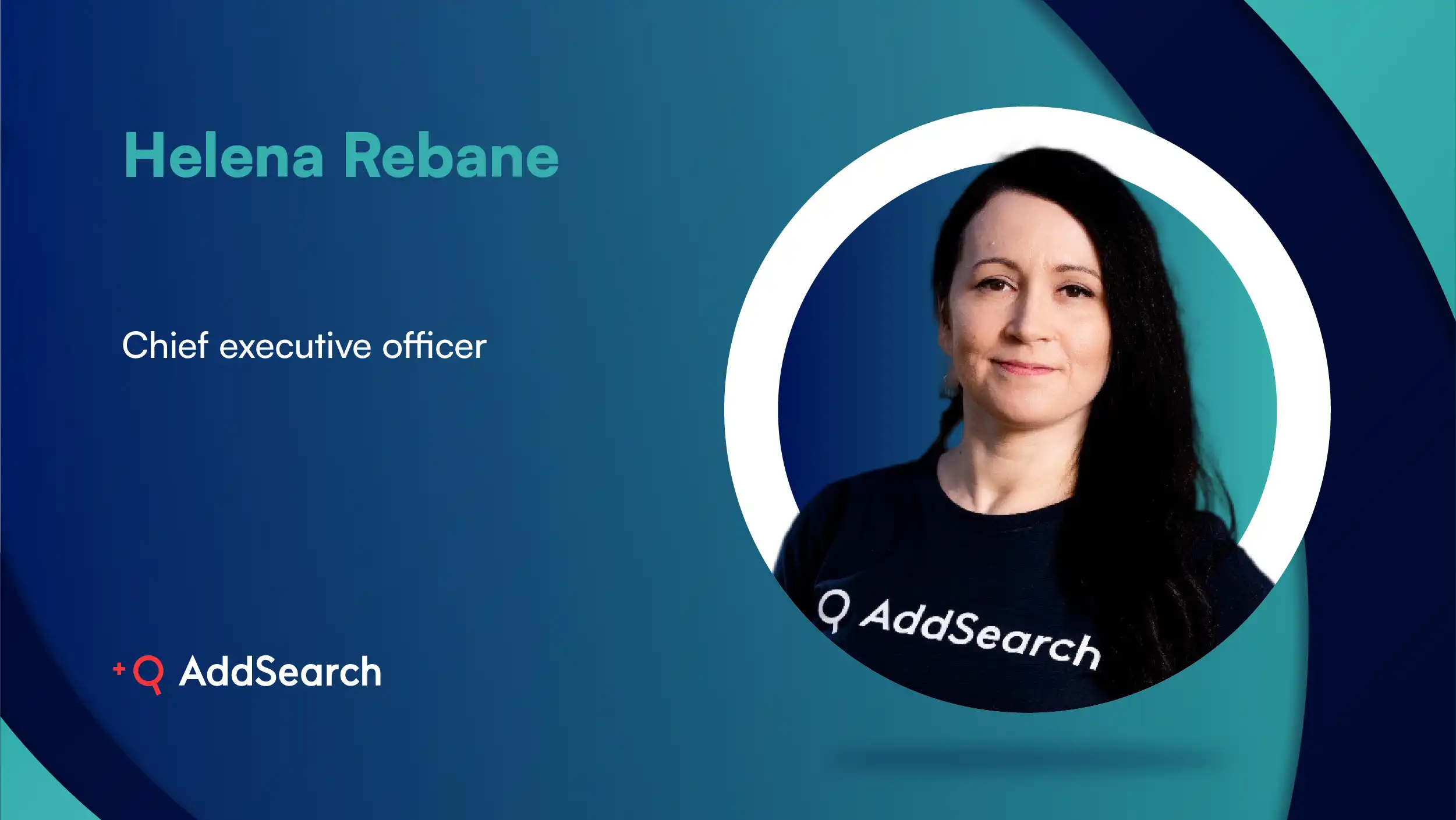
MarTech360 Interview with Helena Rebane, Chief Executive Officer At AddSearch

“The one change I would encourage businesses to make now is to start from intent. Why do your visitors come to your website, and how can you help them fulfil that intent, so they reach their own goal and the website's goal at the same time?”
Helena, you’ve worked across digital services, product operations, and now CEO leadership at AddSearch. How has that journey shaped the way you think about what makes a digital experience genuinely useful to customers?
For me, a digital experience is useful when it creates real value, and that value comes from more than the software alone. The software has to do its job, of course. Nobody wants a tool they pay for every month and then forget about. The experience around it matters just as much.
Working across different functions, from marketing and product to process management, showed me different sides of how value is created. Many of the things that make an experience smooth happen at the back end, where the customer never sees them. They still shape how the product feels to use.
Becoming CEO made the full picture even clearer. Today I try to make sure we look at the whole experience, with the software as one important part of it. It starts with sales, and how it feels when a sales rep guides you through the product and the process. Then comes implementation that goes smoothly, support that is there when you need it, and teams that are good to work with. People want to work with companies they trust and feel connected to. When all of those parts work together, customers rely on the product and keep coming back to it.
Website search has traditionally helped visitors find pages, but conversational AI can help them explore questions and discover answers. What do you think businesses have misunderstood about the role search plays in the customer journey?
With traditional keyword search, many companies saw the search box as a safety net. You added one in case someone couldn't find what they needed by browsing. The smarter companies understood that search is a faster way to discover content, and conversational AI has pushed that much further.
People are now used to finding information through conversations, on websites and well beyond them. When visitors arrive on a website, they usually already know quite a lot about the company, and they are more impatient. They see search as the quickest path to an answer. I think many organizations still haven't caught up with that change.
The second misunderstanding is treating conversational search as a chatbot: a button in the bottom right corner that you open when you get stuck. Discovering content through conversation has become one of the most common ways people look for information. The smartest organizations we work with build it into the whole website experience instead of gluing a conversational tool on top of what they already have.
So the real question is bigger than search. What is the role of the website in the AI era, how does discovery happen there, and how do we build the website so people find what they are looking for?
Also Read: MarTech360 Interview with Michael Leslie, Chief Technology Officer at GetResponse
AddSearch has expanded from keyword search into AI Answers and AI Conversations. What changes in customer expectations are driving this shift, and where do you see the biggest opportunity for businesses to improve the website experience?
The shift started with people. Once they got used to exploring information through conversations with AI tools, they began expecting the same on websites. Our customers, the website owners, noticed it too.
Lone Star College, one of our customers in higher education, told us that more and more of their visitors were arriving from external AI platforms like ChatGPT. Those visitors had already been in conversation mode, and they had already collected a lot of basic information before landing on the site. They didn't want to start from scratch. They wanted to continue the conversation. We heard that directly from customers, and it shaped where we took the product.
The biggest opportunity is helping visitors reach their end goal faster. The next step goes beyond conversation to actually getting things done: signing up for a course, buying a product, booking a demo. That means finding the obstacles in those journeys and removing them, so the website moves people from a question to a completed action with as little friction as possible.
Every search query reveals something about what a visitor wants, what they cannot find, or where they need more clarity. How can businesses turn these signals into better customer insights without losing sight of the intent behind each interaction?
For years, most of the insight from site search came from keywords. You see what was searched and how many times, and that tells you which topics visitors care about. Those are useful signals, but they often miss the intent. You know people searched for "study fees". You don't know why.
Conversational search changes that. Instead of "study fees", you see someone asking, "I'm an international student. What will my first semester cost?" That one question tells you who the visitor is, what they're trying to decide and what they need to hear.
The way to get real insight is to dive into those individual questions. Read the conversations, then analyze them: what people ask, how the conversations flow, where they go next and where they get stuck. That's how you understand the intent behind the numbers.
This kind of data is gold. Most companies never had access to it before conversational AI search. For the first time, they can hear what visitors want to know in the visitors' own words.
Conversational AI gives customers more freedom to ask follow-up questions and explore a topic in their own words. How should businesses design these experiences so conversations lead to genuinely useful answers rather than simply adding another layer of interaction?
It starts with understanding the intent, meaning what the visitor is really asking. Sometimes that means the AI suggests follow-up questions or asks the visitor to say a bit more about what they're looking for.
The part that often gets overlooked is the interface. If the AI gives you a wall of text, it's hard to read, and if it's hard to read, it's hard to act on. A genuinely useful answer has good content, and it's also easy to take in visually.
There are many ways to design for that. Content cards inside the answer can highlight the parts that matter most. Clear buttons and links can take the visitor to the right page or straight to the next action. Comparison views help when people are choosing between options. On a university website, for example, a student could pick two or three courses and see them side by side, with the interface built around that decision.
Good conversational design makes the content easier to use. That's the difference between a useful answer and just another layer of interaction.
Many businesses invest heavily in acquiring website traffic, yet visitors can still struggle to find the information they need. Where do you see AI-powered search making the biggest difference between attracting a visitor and helping that visitor take the next step?
Many websites are losing traffic right now, because more and more content discovery happens outside them. It doesn't hit every industry the same way, but the pattern is clear. The visitors who do arrive are different. They have already done a lot of their research elsewhere, and they come to the website much further along in their thinking.
That changes what the website needs to do. The visitor isn't at the start of their journey, so bombarding them with basic information misses the point. Often they come to verify what they learned elsewhere, and then they want to act.
This is where AI-powered search makes the biggest difference. It lets visitors confirm the details that matter to them quickly, in their own words, and then gives them the tools to take the next step. The businesses that win will make that moment, from checking the facts to taking action, as easy as possible.
AI-generated answers also depend on the quality, relevance, and accuracy of the information behind them. What should businesses do to prepare their content and data so AI can deliver more helpful, consistent, and trustworthy customer experiences?
The quality, relevance and accuracy of content are among the most important factors in AI right now. They decide whether AI gives good answers to visitors on your website, and also to people outside it. External AI agents increasingly use your website's content to answer questions about you.
That's one reason conversational search on your own website is so valuable. You can see the questions visitors ask and the answers they receive. That shows you where your content is out of date, unclear or missing, so you can fix it. When you fix it, you fix it for the external AI tools that read your website too, not just for your own visitors.
Structure matters as well. Clear page structure, good metadata and well-organized information help AI understand what's important and what's current. Treat your content as the source that every AI answer about your business depends on, because increasingly, it is.
Industry research from Gartner in 2026 found that only about one-third of surveyed consumers considered generative AI chatbots as effective as search engines for learning something new. What does this tell us about the gap between the promise of conversational AI and what customers actually find useful?
It tells me that people are at very different stages of the adoption curve. Some already use conversational AI for almost everything, and others still prefer traditional search results. Context matters too. In some situations, a conversation feels natural. In others, the visitor is looking for one specific page and just wants the link.
We thought about this a lot when designing AI Conversations at AddSearch, and we talked about it with our customers. Most of the time, we ended up with a solution that brings the two together. Visitors can explore content through search results and have a conversation about it at the same time, whichever suits them in that moment.
That also gives website owners something valuable. They can see how their own visitors behave and how quickly the shift towards conversation is happening on their site, based on their own data instead of general assumptions.
Different use cases call for different experiences, and that's okay. The gap isn't really between AI and search. It comes from treating one of them as the answer to everything. A good search solution on a website has to be designed with both in mind.
As businesses introduce AI search, what customer signals should they measure beyond search volume and click-through rates to understand whether the experience is actually improving discovery, engagement, and conversion?
With AI search, the metrics themselves are changing. Search volume doesn't tell you much anymore. A drop in volume can mean visitors got their answer quickly and left happy. Fewer click-throughs can mean the answer was enough on its own, or that the website doesn't offer a clear next step. The same number can mean very different things.
So I would start from the goal of the website and work backwards. If the goal is to generate leads through booked meetings, is search actually helping people get there? How could it do that better?
From there, a few questions matter most. Is the AI answering the questions visitors really ask? Are the answers correct? Are they useful? Are the conversations about topics relevant to the business? And when all of that works, how often do those conversations end with the visitor reaching the goal the website exists for?
Every website has its own purpose, so the right metrics will differ. The starting point is always the same, though: how does search and discovery on the website support that goal?
Looking ahead, how do you see website search evolving as conversational AI becomes more capable, and what is one change you would encourage businesses to make now to create more helpful digital experiences?
Search hasn't been just a search box on a website for quite some time, and conversational AI makes very different experiences possible. I see search becoming less of a separate feature and more of the way people move through a website: asking, exploring, comparing, and acting, all in one flow.
The one change I would encourage businesses to make now is to start from intent. Why do your visitors come to your website, and how can you help them fulfil that intent, so they reach their own goal and the website's goal at the same time?
Then look at every part of the conversation that could move them closer. That might mean better-designed links to the next action, product or content comparisons, ways to explore a topic in more depth, or follow-up questions that help visitors say what they really need.
When content discovery becomes part of the whole website experience, and stops being a standalone search box, the digital experience becomes genuinely helpful.
Thanks, Helena!
Helena Rebane is the Chief Executive Officer of AddSearch, where she is leading the company's transition from a traditional website search provider to an AI-first content discovery platform. With a focus on evolving digital experiences, she is guiding the development of solutions that combine keyword search, AI-generated answers, and conversational discovery. Her leadership reflects the changing expectations of website visitors, who increasingly seek direct, relevant answers rather than simply browsing lists of search results. Rebane has also been involved in shaping AddSearch's product direction and go-to-market strategy as the company expands its AI capabilities. Her work highlights the broader challenge facing SaaS leaders: adapting established technology platforms to emerging AI-driven user behaviors while maintaining reliability, relevance, and trust.
