
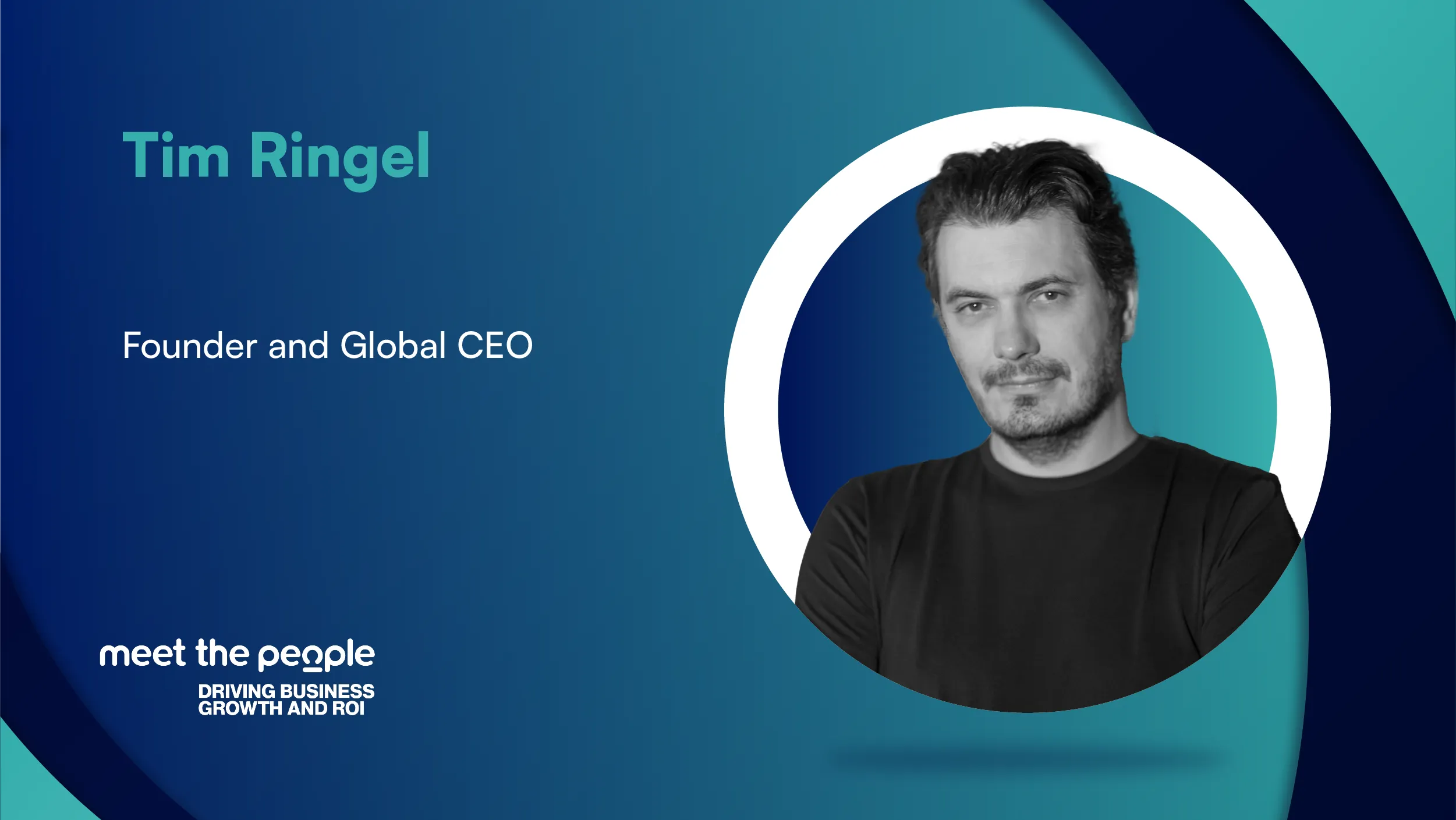
MarTech360 Interview with Tim Ringel, Founder and Global CEO at Meet The People

“The common thread is perspective. A great agency’s job is to see the client’s problem in a broader context than the client can see it.”
Tim, can you tell us about your professional background and your current role at Meet The People?
Sure. I’m the Founder and Global CEO of Meet The People. I started the company in 2021 to build an alternative to the traditional advertising holding company model. We’ve since grown to more than 850 employees across North America through 10 acquisitions. I should also note we’re backed by Innovatus Capital Partners.
The path here has been quite an adventure, which, I’m happy to say, is still ongoing.
I founded my first agency in Germany in 1999. Back then, banner ads were still a novelty. And the industry was arguing about whether the internet would matter to advertisers. That business became metapeople Group. I ran it for 12 years before selling it to NetBooster in 2011.
I then took NetBooster’s CEO seat in London and Paris, moved to New York in 2017 to rebuild Reprise inside IPG Mediabrands. I then ran Spring Studios globally just before starting Meet The People.
Alongside all of that, I’ve been an active investor in more than 50 early-stage technology companies. So the MTP chapter draws on a quarter-century of watching what works and what doesn’t, from inside independent shops and inside the largest networks.
Tim, you’ve spent more than two decades moving between entrepreneurship, agency leadership, international expansion and, now, building an entirely new kind of marketing group. When you look back at the early days of your journey, is there a particular experience that changed the way you think about founders, and that still influences how you build and lead Meet The People today?
I’d say the most formative period was running Reprise inside IPG Mediabrands. We grew from 800 people to 3,000 across 69 offices in three years, which meant absorbing significant amounts of talent through the network. That gave me a close-up view of what happens to founders and senior operators after they enter a large system, and the pattern was consistent.
People who had built and run their own businesses arrived with enormous energy and specific instincts about how to serve their clients. Over time, many of them adapted to the network’s processes rather than the other way around.
That experience shaped how I think about founders to this day. Founders don’t lose their edge because they get acquired. They lose it because the acquiring organization treats their business as something to be optimized rather than something to be strengthened. When we bring an agency into MTP, my starting question is, “What does this founder need to keep operating at the top of their game?” rather than, “What synergies can we extract?” That mental model changes almost every decision that follows.
Also Read: MarTech360 Interview with YouMon Tsang, Founder and CEO at ChurnZero
When you created Meet The People in 2021, you were deliberately challenging a model you had also experienced from the inside. After several years of building MTP, what have you learned about the difference between creating a collection of successful agencies and creating a group that genuinely becomes more valuable because those agencies belong together?
The instinct in agency M&A goes to one of two extremes. You can leave everything alone, in which case you’ve built a collection of agencies that happen to share ownership. Or you can integrate everything, in which case you’ve destroyed the specific value you just paid to acquire.
The useful work sits in the middle, and most of it comes down to correctly identifying which capabilities become more valuable when shared and which become less valuable.
Shared client development is high on the list. When one of our agencies has a strong media relationship with a client, and another has retail media specialization the client needs on Amazon, the group creates real value by bringing those capabilities together at the right moment. The client gets integrated expertise without hiring a second agency. Both agencies grow the account.
Shared technology is another. MTP Intelligence sits at the group level because building it inside any single agency wouldn’t have been economically viable, and its value multiplies as more diverse data flows through it.
What we deliberately keep separate is culture, client leadership, and creative direction. Those don’t scale by centralization. They scale when strong operators have the room to build strong teams around them and then get connected to their peers across the group when it’s genuinely useful.
There is an interesting tension at the heart of MTP. The group has grown by bringing together highly specialized businesses while deliberately protecting their entrepreneurial identities, yet the value proposition depends on those businesses working increasingly closely together. How do you decide what should remain independent and what needs to become shared for the model to work at its best?
The test I apply is whether something functions as a differentiator or as a common good. Creative direction is a differentiator. What makes one of our agencies distinctive from another lives in its creative culture, its specific point of view, its senior talent. Centralizing any of that eliminates the exact reason clients hire that agency in the first place.
Data infrastructure, procurement, financial systems, HR platforms - those are common goods. Every agency needs them. No client hires us because we have a great expense management system. Centralizing them frees the agencies to focus their energy on the work that actually matters.
The harder cases sit between those poles. Business development is a good example. Group-level BD can open doors individual agencies couldn’t reach on their own, particularly with global clients or specialized categories. But if you centralize BD too aggressively, you sever the connections between senior agency leaders and their prospects, and you flatten the specificity that made those agencies attractive in the first place.
The question I keep asking is what would degrade if we made this shared, and what would improve. When the improvement clearly outweighs the degradation, we share it. When it doesn’t, we don’t. It sounds simple. In practice, most agency groups get it wrong in one direction or the other.
The advertising industry is moving from experimenting with AI to embedding it into execution. Research in 2026 shows that nine in ten US marketing agencies now use generative AI, while around half are using agentic AI for marketing execution. From your vantage point, what is the industry still getting wrong about where AI’s real value will come from?
The industry has focused disproportionately on where AI can automate existing work. The more valuable question is, “What AI reveals about how work itself should change?” But that’s barely part of the conversation. If you use AI to do the same tasks faster and cheaper, you compress margins without building any new value. That’s what most agencies are doing right now, and it’s why the industry can produce those 90% adoption statistics while overall profitability keeps declining.
What AI actually shows us is the shape of client problems in ways we couldn’t see before. When you can unify a client’s fragmented data in minutes and generate strategic recommendations directly from what you find, the entire premise of how agencies engage with clients changes.
Work moves toward strategic partnership grounded in evidence the client couldn’t previously access. That’s a different commercial relationship. It commands different fees. It builds different retention.
Agentic AI in execution is a case in point. To me, it isn’t how many workflows you can automate. It’s what the agency now knows about the client’s business that it didn’t know six months ago. If automation isn’t producing that kind of learning, it’s just cheaper labor. And cheaper labor never built long-term value for an agency or its client. And it isn’t going to start now.
MTP has moved beyond adopting AI tools with the launch of MTP Intelligence, bringing data, media, creative, commerce and performance closer together through a shared intelligence layer. As that evolution continues, where do you believe the boundary will settle between what technology should automate, what people should own, and what should remain a distinctly human judgment?
The boundary I see settling is that automation absorbs execution, humans retain judgment about consequence, and the gray zone in between belongs to whoever the client trusts most for the decision at hand.
Execution is the clearest zone. Producing variations of a creative concept, generating first drafts, running scenario analyses across large datasets, monitoring campaign performance in real time - all of this will be handled by AI systems within a few years. Much of it already is. Client teamwork migrates upstream, toward the strategic and architectural decisions that shape what gets produced in the first place.
Judgment about consequence is the human zone. When a creative decision carries meaningful brand risk, when a media investment reallocates a significant piece of a client’s budget, when a campaign response has ethical or political dimensions, humans stay in the loop. The reason is accountability. Consequences need to attach to a person the client can hold responsible, and that requires a human in the decision loop even when AI could technically process the situation.
The gray zone is where most of the interesting work will happen. Should an agent reallocate campaign budget when performance shifts? Should it draft outbound customer communication on the client’s behalf? Should it publish copy under the client’s brand without human review? Those decisions will vary by client, by relationship, by risk appetite. The best agencies will navigate that gray zone thoughtfully and adjust the boundary as trust with each client evolves.
You have built an acquisition philosophy around keeping founders engaged and preserving the entrepreneurial character of the businesses you bring into MTP. As the group becomes larger, how do you protect that founder mindset when scale itself starts creating the systems, processes and layers that successful entrepreneurs usually spend their careers trying to avoid?
Scale always creates pressure toward systems, and the real question is which systems you accept and which you refuse. You can’t run 850 people without HR platforms, finance systems, and coordinated business development. But you can be extremely thoughtful about which systems touch how the work gets done and how founders make decisions.
Three things stay structurally out of the group’s centralized processes. Hiring and firing at the senior levels of each agency, which sits with the founder or CEO of that business. Creative and strategic decisions on client work. And the pace at which each agency evolves its own model.
What we centralize are systems that free up the agencies. Finance and HR platforms remove administrative burden. Shared technology like MTP Intelligence gives founders access to capabilities they couldn’t build alone. Cross-agency business development opens doors individual agencies couldn’t reach on their own. None of that constrains how the agencies actually operate.
The other thing I try to do consciously is protect founders from the corporate calendar. Founders don’t build businesses by attending quarterly reviews or filling in headcount templates. If a founder is spending more than a small fraction of their week on group-level administration, we’re doing something wrong. Their job is to build a great business. Ours is to make that easier.
At the same time, clients are becoming more capable in-house, while expecting external partners to bring deeper specialization, technology and measurable business impact. What do you think the best agencies will need to become exceptionally good at that an in-house team, even a very strong one, cannot easily reproduce?
Three things, and they compound.
Breadth of exposure to problems in-house teams don’t see. An in-house team is deeply expert in one business, and that’s their strength and their limitation. Agencies that work with dozens of clients across categories see patterns the in-house team can’t. When a challenge appears in a client’s market that we’ve already seen in an adjacent industry, we can move on it in weeks. An in-house team is starting from scratch.
Speed of adaptation. The tools, platforms, and consumer behaviors that shape marketing outcomes are changing faster than any single company can track internally. Agencies that treat continuous adaptation as their core discipline stay ahead of that curve. In-house teams, however capable, have other priorities their leadership must attend to.
Specialized expertise at scale. Deep capability in retail media, in AI-enabled data unification, in emerging platform strategies - these are expensive to develop and maintain. They pay off across dozens of clients simultaneously at an agency and rarely justify their cost inside a single company. The best agencies invest at levels in-house teams can’t, and they distribute the value across the client base.
The common thread is perspective. A great agency’s job is to see the client’s problem in a broader context than the client can see it. That’s a permanent structural advantage, and it’s what in-house teams - no matter how strong - can’t easily reproduce.
You have previously spoken about the importance of putting a ceiling on MTP’s eventual scale so that growth does not come at the expense of identity and agility. How do you personally recognize the point at which growth stops strengthening an organization and starts changing what made it special in the first place?
Two signals matter most. The first is what happens when a founder disagrees with the group. In a healthy structure, disagreement produces conversation, and the founder often prevails on their business’s specific ground. When founders start prevailing less because the group has too many stakeholders to move, or when they stop raising disagreements at all because they’ve concluded it isn’t worth the effort, growth has started to change the organization in ways that will cost you later.
The second signal is speed. At our current size, we can make a meaningful strategic decision within days when we need to. Contracting an acquisition timeline, adjusting how a client engagement is staffed, moving quickly on a new capability - these still happen at a pace any entrepreneur would recognize. The day that pace slows measurably is the day scale has started degrading what makes us competitive.
Our stated goal is 1,500-plus employees combining 15-plus businesses across North America, Europe, and Asia. That’s the scale I believe we can reach while preserving what makes MTP work. Whether it’s the actual ceiling depends on how those two signals hold up along the way. If we reach 1,500 people and founder conversations still feel like founder conversations, and decisions still move at entrepreneurial speed, we can consider going further. If either starts to falter earlier, we stop earlier. Identity has to win when it conflicts with ambition.
If you strip away the current headlines around AI, consolidation and the next generation of agency models, what do you think the advertising industry will ultimately rediscover about people that technology cannot replace, and what do you hope Meet The People will have proved about that by then?
Judgment, taste, and trust.
Those three things sit outside what technology can automate, and they’ve always been what separates great marketing from average marketing.
Judgment because decisions in marketing rarely have clean answers. The data supports multiple strategies, the creative options each have merits, the client’s business context shifts every quarter. Making the right call in ambiguity has always been a human capability. AI can support that judgment without substituting for it.
Taste because marketing at its best is a cultural act. It reflects what a moment feels like, what audiences care about, what tone will land and what will fall flat. That kind of pattern recognition draws on lived experience, on understanding people as they actually are. The best creative and strategic minds have always brought that quality to the work, and as AI produces more of the industry’s baseline output, taste rises in value.
Trust because clients ultimately hire specific people they believe in. The relationship between a great CMO and the agency partner they’ve worked with for years is one of the more durable structures in this industry, built through hundreds of small moments of reliability, honesty, and shared commitment. No technology creates that.
What I hope Meet The People will have proved by then is that a modern agency group can scale those human capabilities without diluting them. That you can build a large, technologically sophisticated business while keeping the judgment, taste, and trust that make the work worth doing.
If we’ve done that well, the group’s size will feel like an asset to our people and clients, and the industry will have a working example of what the next era of agency businesses can look like.
Thanks Tim!
Tim Ringel is a marketing and advertising executive, entrepreneur, and agency leader with more than two decades of experience across the global marketing ecosystem. As Founder and Global CEO of Meet The People, he leads an agency group focused on bringing together independent agencies and capabilities across the marketing and advertising value chain. Previously, Ringel held senior leadership roles at Reprise Digital and Spring Studios, managing international businesses across multiple regions. His professional experience spans agency leadership, digital marketing, entrepreneurship, and business development, while his industry involvement includes speaking at major marketing and technology events and participating in advertising industry juries.
